
Squadron Leader Bhawana Kanth Becomes IAF’s First Woman Fighter Combat Leader at Gwalior TACDE

Squadron Leader Bhawana Kanth has become the first woman officer in the Indian Air Force to qualify as a Fighter Combat Leader at the Tactics and Air Combat Development Establishment in Gwalior, adding another major operational milestone to a career already marked by several historic firsts.
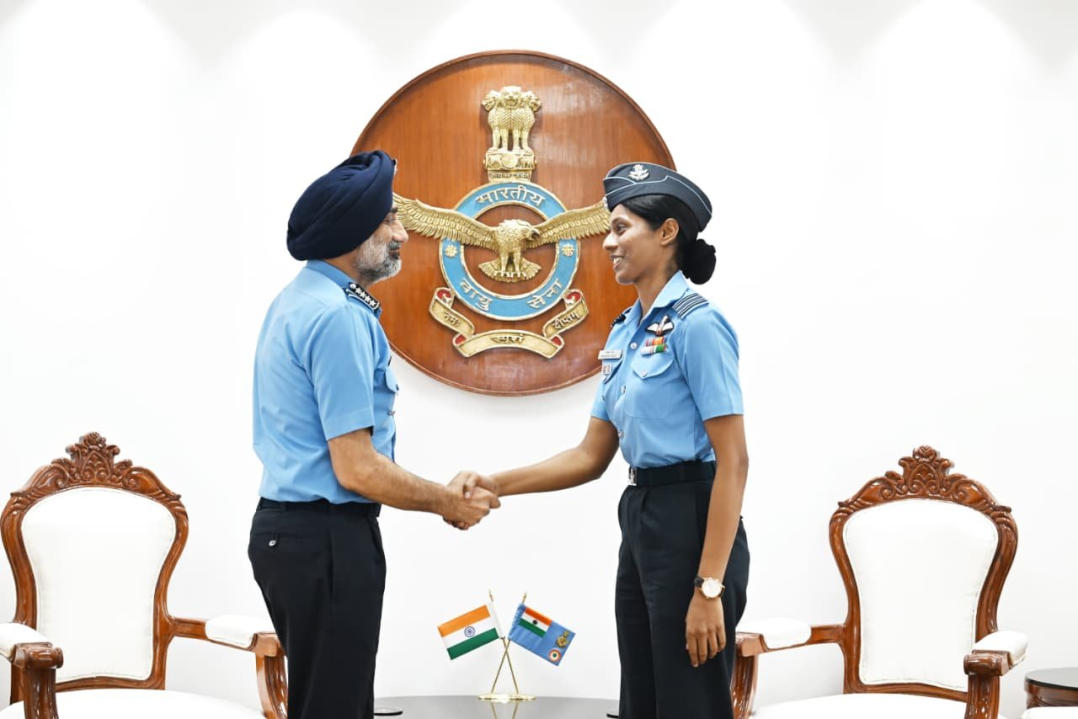
Her qualification was formally recognised by Chief of the Air Staff Air Chief Marshal AP Singh, who felicitated her and presented a commemorative memento. Photographs from the interaction show the Air Chief congratulating Kanth after she completed the demanding course. Official government information from August 2026 confirms that Air Chief Marshal AP Singh continues to serve as Chief of the Air Staff.
An advanced operational qualification
The Fighter Combat Leader, or FCL, course is conducted at TACDE, one of the Indian Air Force’s premier institutions for advanced tactical training and air-combat development. The establishment at Gwalior is responsible for refining air-combat tactics, shaping doctrine and preparing experienced aircrew for leadership responsibilities in complex operational environments.
For a fighter pilot, earning the FCL qualification represents far more than another flying credential. It is an advanced professional benchmark associated with the ability to plan, assess and lead demanding tactical missions. Pilots trained for this role are expected to deal with fast-changing combat situations, coordinate the employment of multiple aircraft and exercise judgment under pressure in contested scenarios.
That is what gives Kanth’s achievement its wider importance within the service. It places her not only among qualified fighter pilots, but within the category of officers prepared for higher tactical responsibility in fighter operations.
What TACDE training represents
TACDE occupies a specialised place in the Indian Air Force’s combat training structure. Its courses are designed to expose select aircrew to advanced tactical flying and complicated mission profiles that sharpen decision-making, situational awareness, mission planning and combat leadership.
The distinction between flying a fighter aircraft and qualifying as a combat leader is significant. Modern air operations require pilots to understand threats, sensors, weapons, electronic warfare and the wider tactical picture, often while coordinating with supporting aircraft and larger formations. Mission leaders may have only seconds to make decisions while operating in difficult and rapidly evolving airspace conditions.
In that context, successful completion of the Fighter Combat Leader course indicates not just flying proficiency, but the ability to evaluate complex tactical situations and employ combat aircraft effectively as part of a larger operational plan.
For Kanth, the qualification marks a transition from being a fighter pilot capable of carrying out demanding missions to an officer trained for advanced tactical leadership.
Another milestone in a pioneering career
Squadron Leader Bhawana Kanth has long been associated with key milestones in the evolution of women’s roles in the Indian Air Force. On June 18, 2016, she was commissioned into the fighter stream along with Avani Chaturvedi and Mohana Singh, forming India’s pioneering group of women fighter pilots. Their induction marked a major change in the range of operational roles open to women officers in the service.
Kanth later became the first Indian woman fighter pilot to qualify for undertaking combat missions during daytime. She also became the first woman fighter pilot to take part in the Republic Day Parade in 2021. In 2024, she was part of the Republic Day flypast, another high-visibility assignment that reflected her standing within the fighter stream.
These milestones have been highlighted by the Government of India as part of its broader documentation of the expanding role of women across the Armed Forces. Her latest achievement at TACDE now extends that trajectory into the domain of tactical leadership.
A decade after women entered the fighter stream
Kanth’s qualification carries added significance because it comes roughly a decade after the Indian Air Force began inducting women into fighter aviation. When Kanth, Chaturvedi and Mohana Singh were commissioned in 2016, the move represented what was then an experimental but transformative shift in personnel policy.
Since then, women fighter pilots have gone on to participate in operational flying, multinational exercises, ceremonial flypasts and other demanding assignments. Government records have also noted subsequent milestones, including Kanth’s daytime combat qualification and Avani Chaturvedi becoming the first IAF woman fighter pilot to take part in an aerial exercise overseas.
The latest development suggests that the first generation of women inducted into the fighter stream is now advancing beyond entry-level breakthroughs and moving through the same professional pathways that shape future tactical leaders and, eventually, command responsibilities.
Recognition from the Air Chief
The felicitation by Air Chief Marshal AP Singh underlined the institutional importance attached to the achievement. Images from the meeting show Kanth in uniform receiving a commemorative memento and interacting with the Air Chief after completing the course.
According to the source article, Air Chief Marshal AP Singh has consistently emphasised operational preparedness, training, technological absorption and sustaining the combat effectiveness of the Indian Air Force. In that context, the recognition of Kanth’s qualification also reflects the service’s focus on professional competence and the development of operational leaders.
Part of a wider shift across the Armed Forces
Kanth’s achievement comes amid the continued expansion of women’s roles across India’s military services. Women officers now serve in a growing range of command, operational, aviation and technical appointments in the Army, Navy and Air Force.
The broader shift has increasingly moved beyond the question of whether women can enter operational streams and toward how they progress within them. In the Air Force, that means not just occupying fighter cockpits, but also moving into specialised and leadership-oriented operational roles.
Kanth’s career illustrates that progression clearly. She entered national attention as one of India’s first women fighter pilots, went on to qualify for combat missions, participated in major national events and continued to build operational experience. By becoming a Fighter Combat Leader, she has now reached another demanding stage in the professional development ladder of a fighter pilot.
Her qualification at TACDE is significant not only because it establishes another first for a woman officer in the IAF, but because it reflects entry into the tactical leadership structure of India’s fighter aviation community.


