
Palki Sharma Upadhyay Joins Future Warfare Course-4 Cognitive Warfare Module at Manekshaw Centre

New Delhi, 19 August 2026: The fourth edition of the Future Warfare Course (FWC-4) has placed the spotlight on one of the most contested aspects of modern conflict — the human mind. At the Manekshaw Centre in New Delhi, a two-day specialised module on Cognitive Warfare brought together journalists, strategic thinkers and subject experts to examine how information, perception and narratives are being used as tools of war.
The course is being organised by Headquarters Integrated Defence Staff (HQ IDS) in collaboration with the Centre for Joint Warfare Studies (CENJOWS). Held from 3 August to 30 August 2026, FWC-4 is intended to prepare military leaders for security challenges shaped by rapid technological change and the growing complexity of multi-domain warfare.
Air Marshal Tejinder Singh, PVSM, AVSM, VM, Chief of Integrated Defence Staff to the Chairman Chiefs of Staff Committee (CISC), attended the cognitive warfare module and interacted with the speakers as well as the officers taking part in the course. His presence reflected the attention being given by India’s senior defence leadership to the non-kinetic aspects of future conflict, where influence and perception can matter as much as firepower.
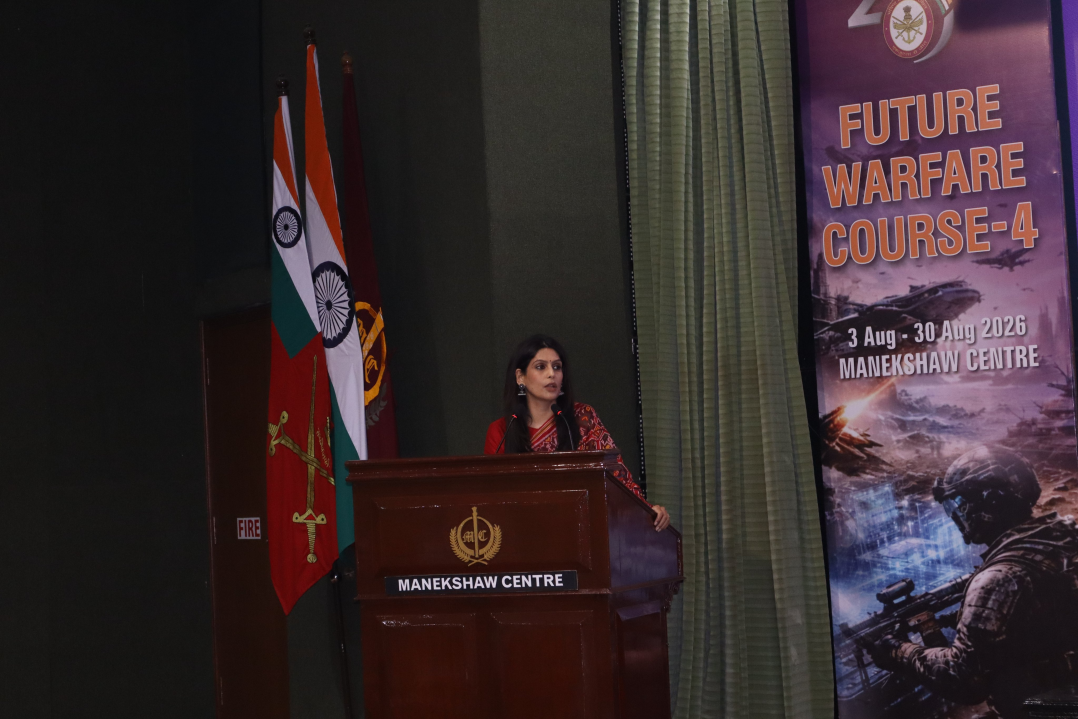
During the event, Air Marshal Tejinder Singh also presented a book on Operation Sindoor to journalist and television anchor Palki Sharma Upadhyay. The exchange at the Manekshaw Centre highlighted the value of bringing military officers and media professionals into the same room to discuss the contest over narratives, public opinion and perception management.
That focus is increasingly relevant because modern warfare extends far beyond conventional combat on land, at sea and in the air. Cyber, space, electromagnetic and information environments are now tightly intertwined with military operations, creating a battlespace in which the cognitive domain has become especially important. It concerns how people — from individual soldiers and commanders to entire populations — perceive events, form beliefs, experience emotions, make decisions and react to events unfolding around them.
Cognitive warfare aims to shape those perceptions and decisions. Rather than destroying a physical target, it seeks to influence the way an adversary interprets a situation and the actions that follow. Such operations can be designed to create confusion, reduce trust in institutions, deepen social divisions, distort public debate or affect the judgments of commanders and political leaders. The rise of digital platforms, artificial intelligence, deepfakes, disinformation and fast-moving online narratives has made these techniques more powerful and more difficult to counter.
CENJOWS has already identified cognitive warfare as a serious national-security concern. Work associated with the think tank has examined threats such as deepfakes and narrative manipulation, along with their potential to erode trust in institutions, while stressing the need for a coordinated response involving both military and civilian stakeholders.
The participation of journalists and other domain experts in the FWC-4 module reflects the reality that the information environment is now inseparable from military operations. A battlefield event can be recorded, interpreted and circulated globally within minutes, while competing narratives may begin to form even before an operation has concluded. In such an environment, the ability to communicate clearly and credibly becomes a critical part of national security.
That also creates new challenges for commanders and planners. Adversaries can use manipulated images, fabricated videos, coordinated social-media campaigns, selective disclosure of facts and AI-generated content to shape how military action is understood by domestic and international audiences. The aim may not always be to persuade everyone of a single false story; sometimes the objective is to flood the information space, generate confusion and make it harder for decision-makers to identify what is true.
The implications extend well beyond public messaging. A sophisticated influence campaign may be intended to affect operational security, cloud intelligence assessments or pressure political and military leaders into acting on incomplete or misleading information. In that sense, cognitive warfare can become part of the decision-making battlespace itself.
The module fits into the broader design of the Future Warfare Course, which is exposing officers to technologies and concepts that are reshaping military operations. Other sessions under FWC-4 have dealt with artificial intelligence and automation in naval operations, network-centric warfare, robotics, Multi-Domain Operations, unmanned underwater vehicles, maritime and underwater domain awareness, autonomous systems and emerging naval warfare concepts.
Taken together, these subjects point to the increasingly interconnected nature of future conflict. A military operation may involve conventional forces, satellites, cyber capabilities, unmanned platforms, AI-enabled command systems, electronic warfare and information operations at the same time. Success or failure in one domain can quickly affect outcomes in another, making integration and rapid decision-making central to military effectiveness.
Yet the cognitive layer cuts across all of these domains. Whether an operation takes place in the mountains, at sea, in cyberspace or through unmanned systems, it creates information that can be interpreted, distorted or weaponised. Understanding how perceptions are formed and how they can be influenced or protected is therefore becoming an essential part of preparing commanders for future wars.
FWC-4 also reflects a wider effort to strengthen interaction among the Armed Forces, the strategic community, academia, technology specialists and industry. CENJOWS, which was established at the initiative of the Ministry of Defence in 2007, is mandated to study joint warfare and promote engagement among government, the armed forces, academia, industry and the broader strategic community.
In that context, the Cognitive Warfare module was more than a discussion on information warfare. It highlighted a shift in military thinking in which control of territory alone may not be enough to achieve strategic aims. The ability to contest narratives, preserve institutional credibility, protect decision-making and communicate effectively during crises is increasingly likely to influence the outcome of military operations.
As technologies capable of producing and spreading convincing content continue to advance, the boundary between the physical and informational battlespaces is likely to become even less distinct. For India’s Armed Forces, preparing leaders to recognise and respond to those challenges will remain an important part of readiness for multi-domain warfare.
Through FWC-4 and focused modules such as the one on Cognitive Warfare, HQ IDS and CENJOWS are attempting to equip participants for a changing character of conflict in which military strength remains vital, but where information, perception, technology and the ability to shape human decision-making can also become decisive instruments of national power.


