
Nepali Army Rescues Hydropower Worker Who Chanted Hare Krishna for 9 Days on Janmashtami

Kathmandu / Rasuwa, 4 September 2026 — A hydropower worker trapped for nine days inside a debris-blocked tunnel in Nepal was rescued alive on Friday, which fell on Krishna Janmashtami, after telling rescuers that he had sustained himself by chanting the Hare Krishna mahamantra throughout the ordeal.
The man, Sanjay Sah, 30, a mechanical foreman with the Nepal Electricity Authority from Saptari district in Madhesh Province, was one of two workers brought out of the tunnel at the Upper Trishuli 3A hydropower project in Rasuwa district. The second survivor, Kabir Maharjan, 45, a mechanical supervisor at the same site, was also pulled to safety after being trapped about 170 metres inside the tunnel.
The rescue came on the Hindu festival marking the birth of Lord Krishna, adding emotional weight to a recovery that had been uncertain for days. Shortly after being carried out, Sah said he had recited the mantra continuously while waiting in darkness. “I was chanting Hare Krishna mahamantra for the past nine days,” he told security personnel. Some accounts also recorded that he invoked the names of Krishna and Hanuman during the period underground.
Security sources said Sah’s condition was stable and that he had no immediate health concerns. He received initial treatment at a local hospital in Trishuli. Maharjan, who required further care for complications, was airlifted to the Nepal Army Hospital in Chhauni, Kathmandu. Officials later said Maharjan’s injuries were more severe than Sah’s.
Sah said he had been working in the project’s control room when the disaster struck on 26 August. A glacial collapse in the upper reaches of the river system sent a mass of ice, rock, water and mud through valleys along the Nepal–Tibet border, burying hydropower works and settlements in its path. He said he directed colleagues toward safer ground and stayed back because he felt responsible for their safety. By the time he tried to leave, the escape route had already been cut off.
“I was working in the control room. My responsibility was to save everyone’s life,” he said. “In doing so, I lost time. In the end, I could not get out myself.”
Even while trapped, Sah said he remained in contact by shouting with three or four other workers nearby. He also said there could still be more people inside the tunnel, including deeper toward the powerhouse, because of the force of the floodwater. “The tunnel is very long. Some people may be trapped inside because of the force of the water,” he added.
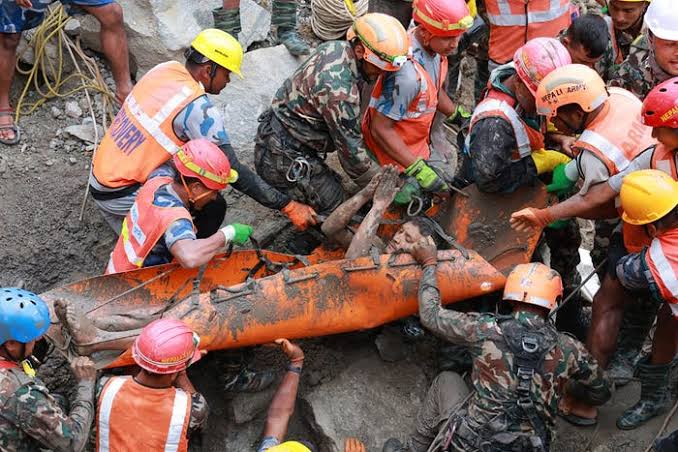
Rescue operations were carried out by teams from the Nepal Army, with support from specialists including Australian tunnel engineer Arnold Dix. Over several days, they cut through mud and rock that had sealed the tunnel. The teams eventually opened a narrow gap along the roof of a cable tunnel and crawled forward, repeatedly calling out for anyone who might still be alive. On Friday, they heard a faint response in Nepali before reaching the two men.
Dix later described the operation as “layer upon layer of miracles”, noting the blocked entrance, unstable debris and the danger of using explosives to clear a passage. Video released by the Nepal Army showed Sah being carried out on a colleague’s back, his face covered in mud, while Maharjan was lifted onto a stretcher as onlookers cheered.
The two men are the first workers known to have been rescued from hydropower tunnels after the 26 August floods. Officials estimate that more than 40 people may have been inside the Trishuli 3A tunnel when the water and debris struck. Hundreds more remain unaccounted for across several projects along the Trishuli and Bhotekoshi corridors. The Independent Power Producers’ Association of Nepal has reported large numbers missing from multiple sites.
By Friday, the confirmed death toll from the floods had risen to about 1,295, with several thousand people still listed as missing and more than 13,000 already rescued from affected areas. Search operations continued at Trishuli 3A and other hydropower tunnels, including sites where rescuers believe survivors may still be sheltering in dry chambers.
For Sah’s family and colleagues, the rescue on Janmashtami carried a special meaning. Relatives of Maharjan described the news as a moment they had almost stopped expecting. Rescuers said the survival of the two men had revived hope that others might still be found alive, even as the chances of further rescues narrowed.
Sah said the mantra had given him the strength to endure nine days without knowing whether help would arrive. He was later moved for continued medical observation as army personnel and engineering teams pressed deeper into the mountain.


