
CDS General NS Raja Subramani Calls for Jointness, AI and Self-Reliance at Coast Guard Conference

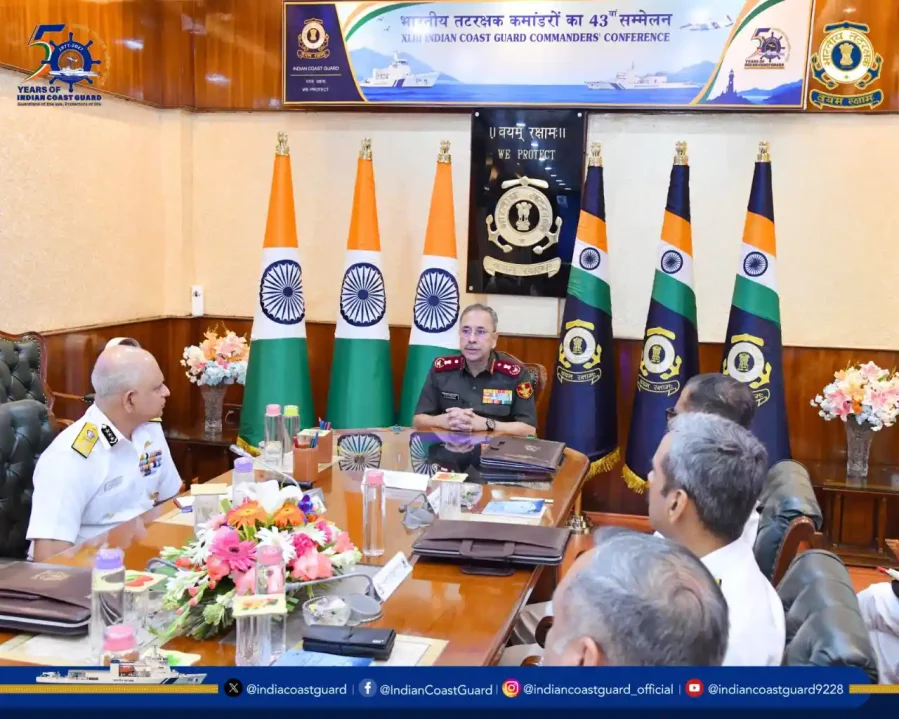
Chief of Defence Staff General NS Raja Subramani, PVSM, AVSM, SM, VSM, on Thursday addressed the Indian Coast Guard’s top leadership at the 43rd Coast Guard Commanders’ Conference in New Delhi, placing joint operations, self-reliance and technology adoption at the centre of India’s maritime security agenda.
The conference, held at Coast Guard Headquarters, brought together senior commanders of the force to review priorities for capability development and operational preparedness. General Subramani used the forum to call for a future-ready Coast Guard that is better integrated with the wider defence establishment and more capable of responding to rapidly changing security challenges at sea.
According to the CDS, the most immediate requirement is greater jointness among the Armed Forces. He stressed that seamless operational coordination between the services is essential as India continues to strengthen its maritime security architecture. In practical terms, greater jointness allows different elements of the defence ecosystem to pool capabilities and resources more effectively when responding to threats across the maritime domain.
He also highlighted the need for accelerated development and operational integration of emerging technologies, with Artificial Intelligence singled out as an area requiring urgent attention. The emphasis on AI reflects the growing importance of faster information processing, improved situational awareness and technology-enabled decision-making in modern military and maritime operations.
But the CDS made clear that technology alone is not enough. He underlined the importance of integrating new systems into existing operational structures rather than treating technological development as a standalone exercise. That, he indicated, also requires training personnel to use such tools effectively so that advances in capability translate into real-world operational gains.
Another major theme of the address was Atmanirbharta, or self-reliance. General Subramani called for continued efforts towards technology-led indigenous capability development, saying India must strengthen its ability to design, develop and sustain critical systems within the country. The push for self-reliance, he said, is closely tied to long-term operational readiness.
He also linked Atmanirbharta to the need for resilient supply chains. For a maritime force like the Coast Guard, which operates continuously across India’s extensive sea areas, reliable access to equipment, components and support systems is vital. Stronger domestic industrial capacity, he suggested, can help reduce dependence on external sources and limit vulnerabilities caused by disruptions in supply.
The conference discussions, therefore, centred not only on equipment and technology but also on the institutional and industrial foundations needed to sustain maritime operations over time. Indigenous manufacturing and a stronger domestic ecosystem can complement operational preparedness while supporting India’s wider maritime security requirements.
The 43rd Coast Guard Commanders’ Conference served as a platform for the force’s senior leadership to assess future capability requirements in an increasingly complex security environment. The presence of the CDS gave added weight to the discussion on convergence across the Armed Forces and the maritime security community.
The Indian Coast Guard remains a key pillar of India’s maritime security framework, with responsibilities spanning the protection of the country’s maritime interests. Strengthening the force through innovation, technology and closer integration with other services is therefore closely linked to the broader task of securing the maritime domain.
General Subramani’s remarks also reflected the wider transformation underway within India’s defence establishment, where greater integration among the three services and other maritime security stakeholders has become a stated priority. For the Coast Guard, closer operational convergence can improve coordination during missions that involve multiple agencies and military formations.
The CDS’s focus on innovation further pointed to the need for new approaches to capability development and problem-solving. Technology adoption, indigenous development and institutional innovation, taken together, were presented as the building blocks of a more adaptable maritime force.
By placing jointness, Atmanirbharta, Artificial Intelligence, innovation and resilient supply chains at the centre of the conference agenda, the leadership meeting outlined the direction in which the Coast Guard is expected to move as India prepares for Viksit Bharat 2047. The priorities discussed in New Delhi were framed as part of a broader effort to build a technologically advanced, self-reliant defence ecosystem and to strengthen integrated maritime operations in the years ahead.


