
Amit Shah Presents President’s Colour to Puducherry Police at Historic Gorimedu Ceremony

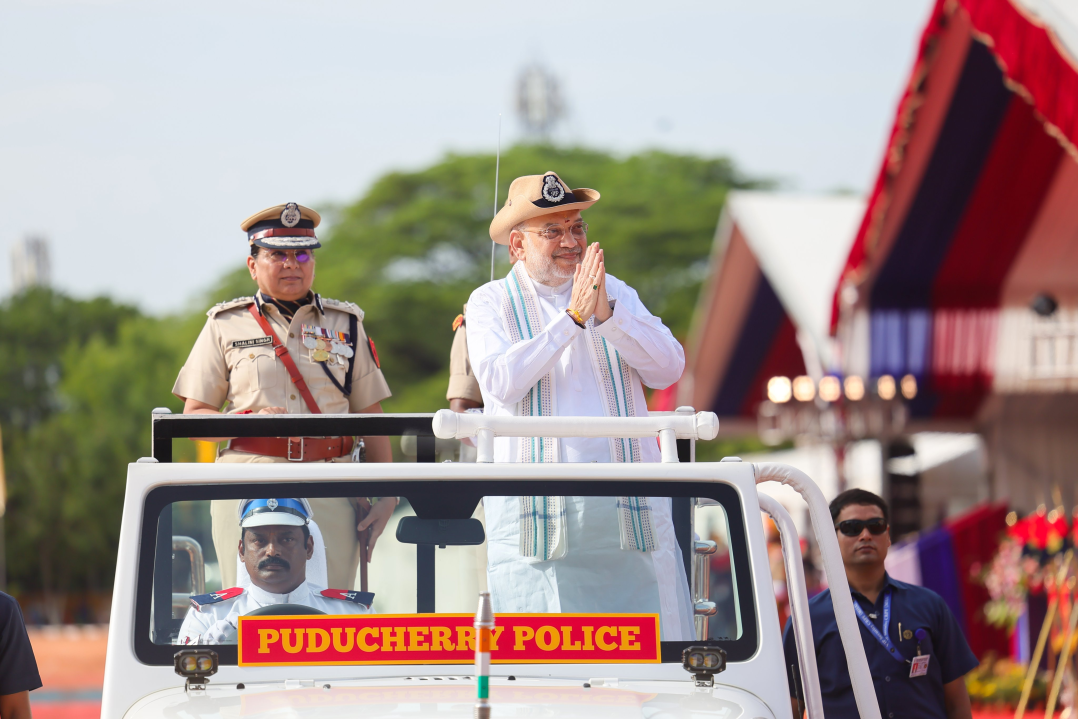
Puducherry, August 9, 2026: Union Home Minister and Minister of Cooperation Amit Shah on Sunday presented the President’s Colour to the Puducherry Police at the Puducherry Armed Police Ground in Gorimedu, formally recognising the Union Territory force for what was described as its exceptional service, discipline and distinguished achievements.
The ceremonial honour, also known as Nishaan or Rashtrapati ka Nishaan, was handed over to the force’s Ensign Officer in the presence of Director General of Police Shalini Singh. With the conferment, Puducherry became the 18th State or Union Territory in the country to receive the President’s Police Colour.
The event was attended by Lieutenant Governor K. Kailashnathan, Chief Minister N. Rangasamy, Home Minister A. Namassivayam, senior police officers, government officials and other dignitaries. The award had been approved by President Droupadi Murmu on May 8, 2026.
Highest ceremonial distinction for a police force
The President’s Colour is the highest ceremonial honour that can be bestowed in India on a military unit, training establishment or State and Union Territory police force. The ceremonial flag serves as a national mark of recognition for courage, professionalism, excellence, discipline and distinguished service in both normal and difficult circumstances.
The tradition draws from older military practices in which colours and standards represented identity, honour and allegiance. In independent India, the honour is presented by the President as Supreme Commander of the Armed Forces, or in the case of police forces when the President is not present, by the Union Home Minister or another designated dignitary. Among earlier recipients are the Indian Navy, which was the first to receive it in 1951, the Indian Coast Guard and several state police organisations. Personnel of a force awarded the Colour usually wear an associated insignia thereafter.
Shah calls it a defining moment for Puducherry Police
Addressing the gathering after the presentation, Shah described the occasion as the “proudest moment in the history of any disciplined force” and called it both a “golden episode” and a “golden chapter” in the history of the Puducherry Police. He extended congratulations and best wishes to the force, the Chief Minister, the Union Territory government and the people of Puducherry.

Shah said the distinction had been earned through the force’s own record. “This honour has not been bestowed upon you merely through an official order or a file; rather, you have earned it through your hard work, valour, service, and dedication,” he said.
He drew particular attention to the unusual policing demands faced by Puducherry Police, noting that the force, with fewer than or around 5,000 personnel, is responsible for maintaining law and order and internal security across four geographically separated regions: Puducherry and Karaikal, both enclaved in Tamil Nadu, Yanam in Andhra Pradesh, and Mahe in Kerala. Despite this fragmented jurisdiction, he said, the force had maintained “very high standards of flawless professionalism” while also safeguarding the Union Territory’s “glorious spiritual heritage”.
Shah also recalled the role of the force during the COVID-19 pandemic. He said that while reviewing the situation in states and Union Territories from the Ministry of Home Affairs, he had observed Puducherry Police personnel standing on the front lines with courage and serving the public, including senior citizens, women and children. “I will always remember your bravery and dedication,” he said.
In a broader cultural reference, the Home Minister described Puducherry as “a vibrant symbol of the spiritual consciousness and cultural consciousness of South India”. He said that even after a period of French administration, the region had preserved its Indianness and spiritual energy.
During his address, Shah also referred to the replacement of British-era criminal laws, including the Indian Penal Code, with the Bharatiya Nyaya Sanhita and related new laws. He said the new legal framework had been enacted to ensure justice for citizens and was built on the “three pillars of technology, timeline and trust”.
He used the occasion to underline the Centre’s development push in the Union Territory under Prime Minister Narendra Modi’s leadership. According to Shah, Puducherry received around Rs 3,500 crore in Central fund allocation between 1950 and 2014, while the NDA government provided Rs 13,762 crore during the 2014-26 period.
He also cited investments of Rs 39,000 crore over the last nine years, major road expansion works, and the reach of welfare schemes such as Lakhpati Didi, Ujjwala, PM Awas, direct benefit transfer and toilet construction. These measures, he said, had benefited around seven lakh citizens in Puducherry. “In this golden hour, let me assure on PM Modi’s behalf, the government is committed to the union territory’s development,” Shah said.
Shah arrived in Puducherry on Saturday, where he was received by Chief Minister N. Rangasamy, cabinet ministers, legislators, BJP state president V.P. Ramalingam and others. Before reaching the Union Territory, he offered prayers at the Arulmigu Arunachaleswarar Temple in Tiruvannamalai, Tamil Nadu, and visited Sri Ramanasramam, where he sought blessings for the well-being of citizens and recalled the teachings of Bhagwan Sri Ramana Maharshi.
Authorities had put in place elaborate security arrangements for the visit and the ceremonial event. More than 1,000 personnel from the Central Reserve Police Force and the Puducherry Police were deployed, accompanied by intensified vehicle checks, traffic regulations and a ban on drones and other aerial devices.
The Puducherry Police traces its origins to the French colonial era, before the territory’s 1954 merger with India, and still retains distinctive features such as the French-style kepi in its uniform tradition. The force has jurisdiction across all four regions of the Union Territory and operates under the overall control of the Ministry of Home Affairs.
Its structure includes specialised units for traffic, which are notable for investigation powers, as well as CID, cyber crime, anti-human trafficking and other functions. The President’s Colour therefore recognises not only ceremonial distinction but also the sustained operational role of the force in a uniquely configured Union Territory spread across multiple states.
Later on Sunday afternoon, Shah was scheduled to flag off a ‘Har Ghar Tiranga’ rally at Muruga Theatre Signal as part of the national campaign.
In a post on X after the ceremony, the Home Minister said he was proud to honour the Puducherry Police, calling the award “a befitting accolade to its courage and dedication” in overcoming the challenge of policing a territory divided into four geographical areas while protecting its spiritual heritage. He congratulated all personnel of the force as well as the people of the Union Territory.
Sunday’s presentation formally places the Puducherry Police among a select group of police organisations in India to have received the President’s Colour, a national acknowledgement of its professionalism, service ethos and contribution to internal security.


