Why Do Jats, Rajputs, and Jat Sikhs Make Up the President’s Bodyguard?

The President’s Bodyguard, known as the PBG, stands out as one of the Indian Army's most prestigious and visually impressive units. Based at Rashtrapati Bhavan, this regiment is responsible for ceremonial duties for the President of India and functions as a trained operational military unit. Renowned for its mounted escorts, polished uniforms, and disciplined troopers, it holds a significant role during national events like Republic Day, state visits, and formal functions at the President’s Estate.
A recurring topic of debate is why only Jats, Rajputs, and Jat Sikhs are recruited as troopers in the President’s Bodyguard.
The rationale behind this lies in history, regimental tradition, ceremonial needs, and military policy. While modern India adheres to principles of equality, the Indian Army asserts that the PBG's fixed-class composition aligns with the unit's unique functional and ceremonial roles rather than social identity.
The President’s Bodyguard is the Indian Army’s oldest regiment, established in 1773 as the Governor-General’s Bodyguard and later renamed on January 27, 1950, when India became a republic.
The President’s Bodyguard is the senior-most regiment in the Indian Army, serving as the personal ceremonial escort to the President of India, who is the Supreme Commander of the Indian Armed Forces.
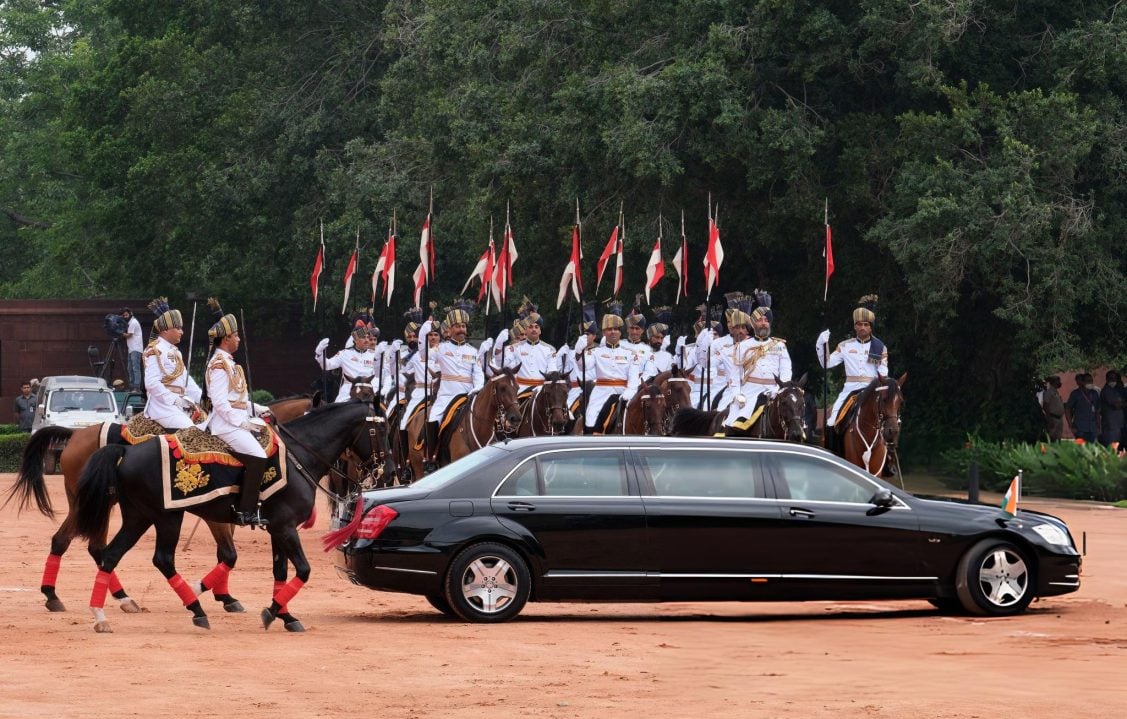
The unit is famed for escorting the President during key national and diplomatic events. Troopers are seen on horseback during ceremonial occasions, adorned in traditional uniforms and carrying lances. Their presence at Rashtrapati Bhavan symbolizes military discipline, heritage, and state honor.
However, the PBG is not solely a ceremonial unit. It is also a combat-trained segment of the Indian Army, with soldiers skilled in military operations, armored warfare, and airborne missions. The regiment has a history of contributing to operational duties in challenging regions beyond ceremonial parades.
Recruitment for troopers in the President’s Bodyguard traditionally includes three communities:
| Community |
|---|
| Jats |
| Rajputs |
| Jat Sikhs |
The regiment operates under a “fixed class” system, whereby soldier recruitment is limited to specific classes or communities.
This structure is generally maintained with equal proportions among the three communities, with roughly one-third representation each from Jats, Rajputs, and Jat Sikhs.
It is crucial to note that this restriction primarily applies to troopers. Officers in command are selected through the Indian Army’s regular officer selection process and may come from any region, religion, caste, or community. Similarly, administrative and support staff may also be sourced from outside these three groups.
The Indian Army has historically employed various regimental compositions. Some regiments operate on an “All India, All Class” basis, recruiting soldiers from across the nation. In contrast, others adhere to class-based, region-based, or community-based traditions, especially older infantry and cavalry regiments.
The PBG adheres to the older tradition of fixed-class regiments. The Army argues that such a structure preserves regimental identity, cohesion, discipline, and continuity.
For the President’s Bodyguard, ceremonial requirements also play a crucial role. The unit represents the President during significant state events, and uniformity in appearance is deemed important. Troopers must exhibit a tall, impressive, and consistent physical presence.
The PBG maintains very strict physical standards, often associated with a minimum height of around 6 feet for recruitment. The Army claims that the traditional recruiting communities have historically provided candidates who meet the required height, build, riding ability, and ceremonial bearing.
The President’s Bodyguard is among India’s most visible military units, appearing before foreign dignitaries, heads of state, ambassadors, military leaders, and the public during key ceremonies.
Visual uniformity is thus considered essential. Troopers are expected to look similar in height, physique, posture, and parade bearing. Even minor discrepancies in alignment, height, and movement can become noticeable during ceremonial events.
The Army has said that the PBG serves as a “show window” of military tradition. Its duty is not only to protect and escort the President but also to reflect the dignity of the Indian state. The tall mounted troopers, polished ceremonial attire, horses, lances, and disciplined formation are integral to this visual tradition.
This is one of the primary reasons for maintaining the fixed-class system.
The origins of the PBG trace back to the colonial era, established in 1773 during Warren Hastings' tenure. At the time, military recruitment followed the British concept of “martial races,” which classified certain communities as more suited for military service.
This classification is a colonial concept and is not recognized in modern social principles. However, many regimental structures established during that era persisted post-Independence, especially those linked to longstanding traditions and operational cohesion.
Before Partition, the bodyguard comprised communities such as Punjabi Muslims, Sikhs, and Rajputs. Following Partition in 1947, Muslim troopers joined Pakistan's equivalent bodyguard. The Indian unit retained Sikhs, Jats, and Rajputs, eventually formalizing the current composition.
After India became a republic, the unit was renamed the President’s Bodyguard on January 27, 1950. Since then, it has remained attached to Rashtrapati Bhavan, continuing its ceremonial role under the President of India.
There is a common misconception that the PBG is solely a ceremonial unit.
Despite its ceremonial fame, the PBG is also a trained military unit. Soldiers are not just chosen for their appearance; they are trained in combat skills, weaponry, horsemanship, military discipline, and operational duties.
The PBG has been involved in challenging operational areas and engagements like Siachen, Sri Lanka, and United Nations peacekeeping missions. The unit has maintained its armored and airborne traditions as well.
The PBG is unique in its triple identity:
| Identity |
|---|
| A ceremonial guard of the President |
| A cavalry heritage unit |
| A combat-trained military formation |
The President’s Bodyguard is thus not only about horses, uniforms, and parades. Its soldiers are expected to meet high military standards alongside ceremonial duties.
The fixed-class recruitment policy has faced challenges from candidates and petitioners who argue for inclusion of physically qualified candidates from other communities.
The primary objection centers on constitutional equality. Critics argue that limiting recruitment to just three communities might contravene the spirit of equal opportunity in public service. They reference constitutional principles like equality before the law and non-discrimination.
The argument is straightforward: if a candidate from another community meets the required height, fitness, riding skills, and military standards, why should he be excluded due to his community not being Jat, Rajput, or Jat Sikh?
This question has led to legal challenges and public discourse.
The Indian Army has defended its policy, stating that the PBG's recruitment model is not general employment but pertains to military organization, tradition, and functional necessity.
The Army maintains that the PBG's unique ceremonial role is maintained through its current composition, which supports uniformity, regimental identity, and ceremonial excellence.
In earlier court proceedings, reports indicate that the Army argued the recruitment pattern is not a form of caste discrimination but is tied to the unit’s functional requirements. The issue has been raised in courts, addressing challenges related to Articles 14, 15, and 16 of the Constitution concerning equality and non-discrimination.
Courts have generally hesitated to interfere with military recruitment policies, especially when the armed forces cite operational or functional necessities. However, the debate endures publicly as it involves both military tradition and constitutional equality.
The PBG debate embodies a broader question within the Indian Army: how should historical regimental traditions be reconciled with the modern ideal of equal opportunity?
The Army comprises many regiments with traditional compositions, some based on region, class, and others on an all-India basis. These traditions are often justified through esprit de corps, morale, historical significance, and cohesion.
Conversely, India is a democratic republic where institutions are expected to reflect fairness and equal access, prompting criticism of the PBG’s recruitment policy.
Proponents argue that the PBG is a specialized unit with distinct ceremonial responsibilities. Its fixed-class composition should be seen as a regimental tradition rather than a standard recruitment practice.
Detractors contend that tradition alone should not supersede constitutional values, particularly when the armed forces represent the entire nation.
The issue is sensitive as it touches upon caste, military pride, constitutional values, and national symbolism.
The President’s Bodyguard is affiliated with the office of the President of India, the nation's highest constitutional office, making any perception of exclusion a matter of public concern.
Simultaneously, the PBG is an old military regiment with a carefully preserved identity. For the Army, regimental traditions are not mere symbols; they are vital for discipline, loyalty, and continuity.
Thus, the issue cannot be viewed through a single lens. It is not solely a caste matter, nor only a ceremonial one. It encompasses history, military policy, legal interpretation, and evolving social expectations.
Presently, the President’s Bodyguard continues its traditional fixed-class composition for troopers. Jats, Rajputs, and Jat Sikhs are the primary recruiting communities for soldier-level roles in the regiment.
The Army upholds that the policy is rooted in historical and functional considerations, while critics question its place in contemporary India.
The debate is likely to persist as it taps into a larger query: should the armed forces retain old regimental traditions unchanged, or should such units gradually open up to broader participation?
The President’s Bodyguard is among India’s most elite and historic military units. Its restricted recruitment pattern stems from colonial-era military traditions, post-Partition restructuring, ceremonial needs, and the Army’s fixed-class regimental system.
The reason for recruiting only Jats, Rajputs, and Jat Sikhs is not merely a matter of social preference. The Army’s stance is that these communities have historically produced candidates who meet the unit’s physical, ceremonial, and regimental requirements. The unit’s role at Rashtrapati Bhavan necessitates exceptional height, bearing, discipline, and visual uniformity.
However, the policy remains contentious as it seems to restrict equal opportunity for candidates from other communities who meet the same physical and military standards.
Ultimately, the PBG stands at the crossroads of tradition and modern constitutional values. It symbolizes India’s military heritage, yet poses an essential question for the future: how should a modern republic balance historic military customs with the promise of equal opportunity for all citizens?