
Rolls-Royce Proposes Full IP Rights in Joint Development of AMCA Mk2 Engine in India

New Delhi, June 2026: The competition to develop the engine for India’s Advanced Medium Combat Aircraft (AMCA) programme is intensifying as British aerospace giant Rolls-Royce proposes co-developing a next-generation fighter engine in India, including full intellectual property rights.
This proposal pits Rolls-Royce against French defence firm Safran in vying for one of India's key defence technology alliances. The rivalry underscores India's determination to gain complete control over crucial fighter-engine technology as the nation advances its first indigenous fifth-generation stealth fighter project.
Rolls-Royce Makes a Major Pitch for AMCA Mk2 Engine
Rolls-Royce has offered to co-develop a new fighter jet engine for the AMCA programme, promising full technology transfer and intellectual property rights for India. The proposed engine is aimed at the advanced AMCA Mk2 variant, requiring a higher-thrust powerplant than the initial AMCA Mk1 version.
Public reports reveal that Rolls-Royce intends to develop this engine in India, fostering an aero gas-turbine ecosystem in the nation. Sashi Mukundan, Rolls-Royce Executive Vice President for Transformation in India, noted the company's readiness to engage in a deep co-development model with Indian collaboration, backed by the UK government.
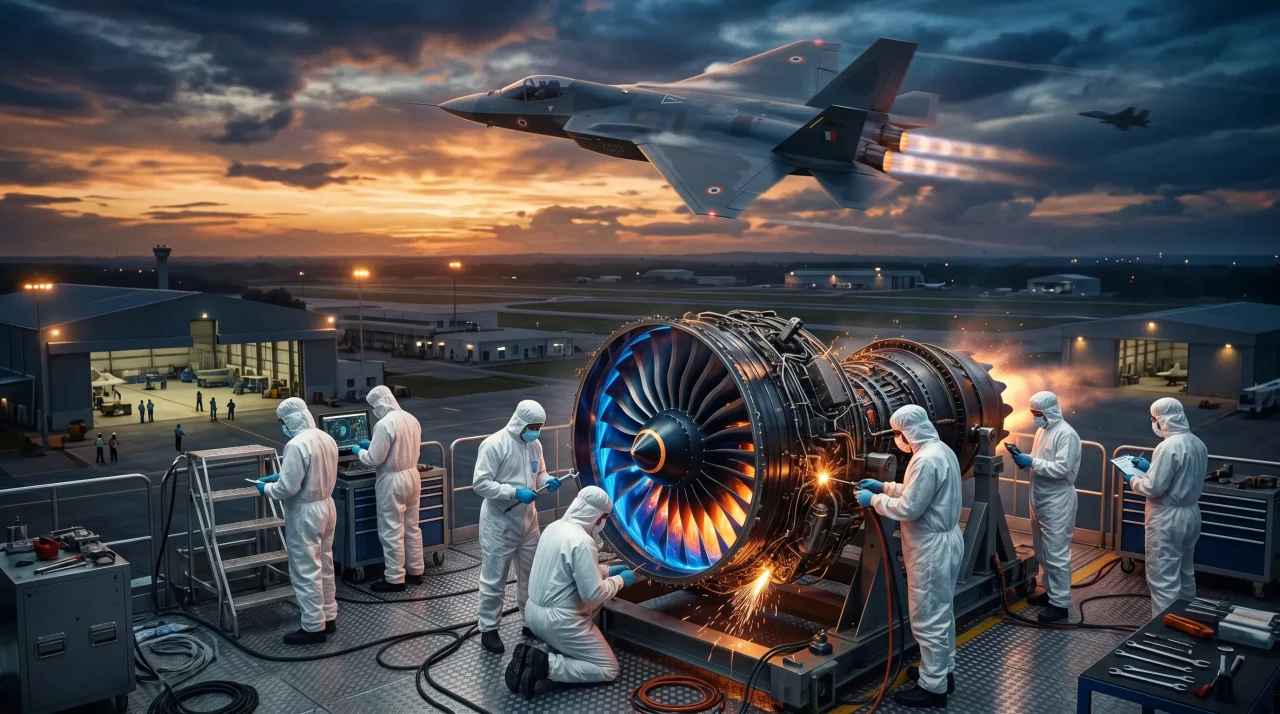
The engine is anticipated to offer thrust between 110–130 kN, fitting for a fifth-generation stealth aircraft like the AMCA Mk2. Rolls-Royce aims for ground testing around 2032, with the first flight of the engine around 2034, aligning with India's AMCA development timeline.
This proposal extends beyond conventional licensed production, involving deeper Indian engagement in design, engineering, development, testing, certification, upgrades, and future engine derivatives.
Why the Engine Matters for AMCA
The AMCA is India’s most ambitious fighter aircraft development initiative. Designed as a twin-engine, single-seat, fifth-generation stealth multirole fighter, the project is led by the Aeronautical Development Agency under DRDO, with input from HAL and Indian private industry.
The aircraft is set to include features like low radar cross-section design, internal weapons bays, advanced sensors, electronic warfare capabilities, sensor fusion, precision strike capabilities, and high-end air superiority performance.
The AMCA programme is divided into two main variants.
The AMCA Mk1 will employ General Electric F414 engines, already linked with India’s Tejas Mk2 and initial AMCA needs, providing a proven powerplant for the project's first phase.
Conversely, the AMCA Mk2 will require a more potent engine in the 120 kN class, crucial for enhancing thrust-to-weight ratio, payload and range, thermal management, and sustained performance. For a fifth-generation stealth fighter, propulsion impacts not only thrust but also stealth, endurance, heat signature, weapons load, and future upgrade prospects.
Safran Remains a Strong Competitor
Rolls-Royce faces competition from French defence heavyweight Safran, which is also pursuing a fighter-engine partnership with India. Safran is seen as a formidable contender for the AMCA Mk2 engine project, particularly given India’s exploration of a long-term co-development model for a 120 kN-class engine.
Safran’s plan reportedly involves collaboration with DRDO’s Gas Turbine Research Establishment, drawing on experience from the Kaveri engine programme. While the Kaveri engine did not result in a production-ready fighter engine, it provided India with valuable insights into gas turbine design, materials, testing, and integration.
Rolls-Royce's offer of full-IP rights has intensified the competition. For India, the decision will weigh not just on technical performance but also on design ownership, modification freedom, hot-section technology transfer, local manufacturing depth, development timelines, and long-term strategic control.
Full IP Rights: The Key Strategic Factor
The cornerstone of the Rolls-Royce offer is the provision of full intellectual property rights for India. In fighter engine development, IP ownership is vital, as engine technology is among the most closely held secrets in military aviation.
For India, acquiring full IP rights would enable upgrades, modifications, and maintenance of the engine without external constraints. It would also empower Indian agencies and industries to develop future variants for other aircraft, unmanned combat platforms, and next-generation fighter programmes.
This is crucial because India has often faced hurdles in obtaining critical propulsion technologies from foreign suppliers. Even when engines are imported or licence-manufactured, core technologies like single-crystal turbine blades, high-pressure compressors, advanced combustors, thermal barrier coatings, digital engine controls, and high-temperature materials are seldom fully transferred.
A genuine co-development model with Indian ownership would therefore signify a major transition from dependence to capability creation.
AMCA Programme Moves Ahead Under Industry Partnership Model
The AMCA programme has received substantial government support following the Cabinet Committee on Security's approval. The Defence Ministry is also advancing an industry partnership model to involve both public and private sector companies in prototype development, flight testing, certification, and eventual production.
Under the current plan, the AMCA prototype rollout is expected around 2028–29, followed by a first flight around 2029, service introduction around 2034, and series production by 2035.
This makes the engine decision time-sensitive. While AMCA Mk1 can proceed with the GE F414 engine, the Mk2 variant will depend on India finalising a foreign partner and commencing serious development of the higher-thrust engine within the current decade.
Lessons from the Kaveri Programme
India’s previous attempt to develop an indigenous fighter engine through the Kaveri programme did not fully meet the Tejas fighter's requirements. Yet, the programme contributed to India's understanding of engine design, testing, materials, combustion, controls, and integration.
The AMCA engine partnership aims to build on this experience. The goal now is not merely to import an engine but to establish a national aero-engine capability that can serve India for decades.
This is why DRDO, GTRE, HAL, private industry, academic institutions, and foreign partners will all play crucial roles. The success of the AMCA Mk2 engine will hinge on how much design knowledge and manufacturing capability India can absorb.
Strategic Importance for Indian Air Force
For the Indian Air Force, the AMCA is central to future combat capabilities. The IAF faces a swiftly evolving airpower landscape, with China deploying fifth-generation aircraft and Pakistan deepening its military aviation ties with Beijing.
A successful AMCA programme would equip India with an indigenous stealth fighter capable of operating in contested airspace, reducing long-term reliance on imported platforms like the Rafale, Su-30MKI, and potential future foreign-origin fighters.
However, no fifth-generation fighter programme can succeed without a reliable, powerful, and upgradeable engine. The engine selected for AMCA Mk2 will determine the aircraft’s long-term combat potential.
A Defining Decision for India’s Aerospace Future
The Rolls-Royce offer has injected new energy into the AMCA engine competition. Safran remains a significant contender, while Rolls-Royce seeks to set itself apart with full IP rights, deep technology transfer, and development within India.
For New Delhi, the final decision will have ramifications far beyond a single aircraft. It will shape India’s fighter engine ecosystem, influence future manned and unmanned aircraft programmes, and decide whether India can evolve from licensed manufacturing to true aerospace design leadership.
The AMCA engine decision is thus not merely a procurement choice but a strategic technology determination.
If India secures a true co-development partnership with full ownership, the nation could finally overcome one of the most challenging barriers in military aviation: the ability to design, develop, produce, and upgrade a modern fighter-class jet engine.
As negotiations continue, the coming months will be closely observed by defence strategists, the Indian Air Force, aerospace industry stakeholders, and strategic analysts. The outcome will play a decisive role in advancing India’s fifth-generation fighter ambitions into the mid-2030s and beyond.


