Major General Sachin Mehta and Officers Survive Cheetah Helicopter Crash in Ladakh

In a dramatic occurrence in the high-altitude area of Ladakh, three officers of the Indian Army, including a Major General, survived a crash involving a Cheetah helicopter near Tangste, close to Leh. The incident, which took place on Wednesday, could have led to a major tragedy, yet all three officers on board escaped with only minor injuries and received medical care shortly after.
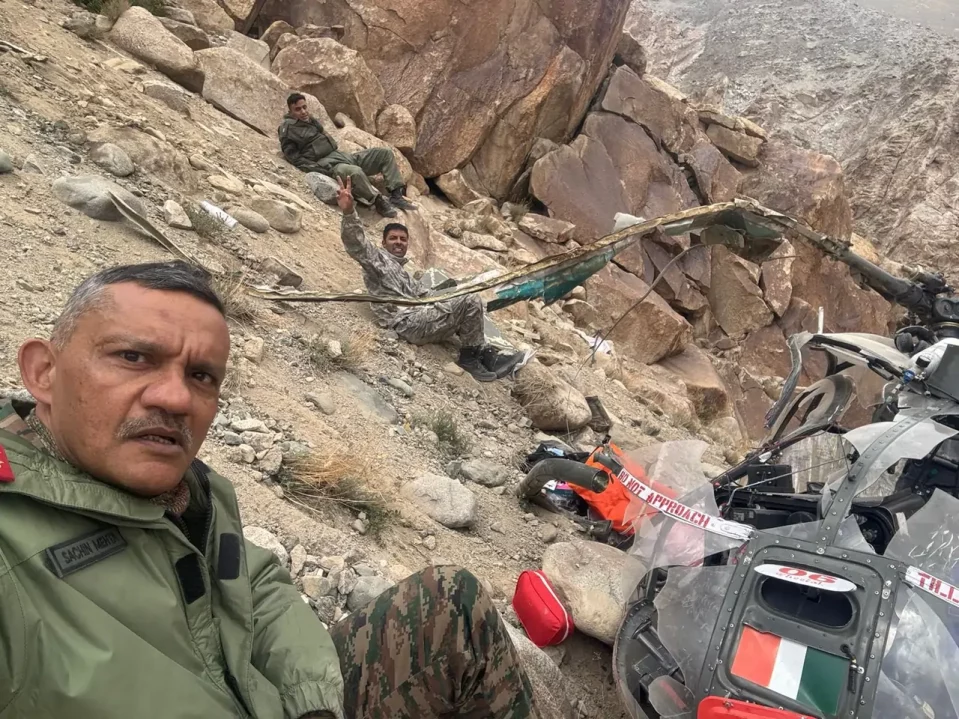
The incident gained significant attention due to a photograph from the crash site, dubbed an iconic selfie, which shows Major General Sachin Mehta and the other officers safe following the accident. The image has come to symbolize bravery, composure, and fortune in a situation that could have been lethal, especially given the challenging mountainous landscape of Ladakh and the delicate nature of helicopter operations in such demanding environments.
The helicopter was piloted by a Lieutenant Colonel and a Major, with Major General Sachin Mehta, General Officer Commanding of the 3 Infantry Division, on board as a passenger. It was reportedly on a sortie in the area when it crashed in the Tangste region. While the exact cause of the crash remains unclear, the Indian Army has initiated a formal investigation to ascertain the technical or operational factors that might have contributed to the accident.
Officials with knowledge of the situation stated that all three occupants managed to exit the wreckage safely, an outcome described as remarkable given the location and nature of the crash. The Tangste area is situated in the rugged mountainous region of eastern Ladakh, where weather, altitude, terrain, and operational pressures pose significant challenges to even the most experienced pilots.
The HAL Cheetah helicopter has been a vital component of Indian Army aviation for decades. It is a license-built version of the French Alouette III and has been extensively used in some of the country's most challenging operational zones, including the Siachen Glacier and high-altitude forward areas along the northern borders. Its capability to operate in thin air and difficult terrain has made it crucial for medical evacuations, reconnaissance, logistical support, and troop movements in remote areas.
Nonetheless, the recent crash has once again brought attention to the age and safety concerns of the Cheetah and Chetak helicopter fleets. These helicopters have been in service for a long time and are critical for high-altitude missions, yet several crashes over the past decade have raised questions about the urgency for modernization. Reports indicate that over the last 10 to 12 years, more than 15 Cheetah and Chetak helicopters have been involved in crashes, leading to the loss of numerous pilots and crew members.
Despite these concerns, Army sources assert that the existing Cheetah fleet remains technically airworthy and still has a limited service life. However, the incident underscores the operational risks associated with aging aircraft, particularly in regions like Ladakh, where helicopter support is essential for military mobility and emergency response.
The Indian Army has already outlined a modernization plan for the Army Aviation Corps. As part of this strategy, the aging Cheetah and Chetak helicopters are slated to be gradually phased out and replaced with new-generation Light Utility Helicopters over the coming years. This transition is expected to span eight to ten years, considering the operational requirements and the number of helicopters needed.
The Army requires approximately 250 new light utility helicopters to fulfill its long-term needs. To address this, a two-pronged approach is being implemented, which involves the induction of indigenously developed Light Utility Helicopters by Hindustan Aeronautics Limited, along with short-term leasing to meet immediate capability needs.
HAL’s Light Utility Helicopter is anticipated to play a significant role in this transition. The Army has already placed orders for six limited-series-production LUHs. These helicopters are designed with improved safety, performance, and reliability, featuring a top speed of around 220 kmph, a service ceiling of 6.5 km, and an operational range of about 350 km. Such capabilities are deemed crucial for missions in high-altitude areas like Ladakh and Siachen.
The crash near Tangste occurs as India intensifies its efforts to modernize rotary-wing aviation assets for the armed forces. Helicopters are indispensable in the Ladakh sector due to the region’s difficult road connectivity, extreme weather, and strategic importance. They serve as a lifeline for military operations in the Himalayas, from transporting supplies to evacuating casualties and supporting troops stationed in forward locations.
For the moment, the immediate relief is that no fatalities occurred in Wednesday’s accident. Major General Sachin Mehta and the two pilots were treated for minor injuries and are reported to be safe. The Army's inquiry will thoroughly examine the circumstances surrounding the crash and suggest measures to prevent future incidents.
The photograph of the officers post-crash adds a human element to the incident. In a profession where danger is a constant companion, the image serves as a reminder of the risks faced by Indian Army aviators and officers operating in some of the world’s most unforgiving terrains. It also highlights the necessity of accelerating the replacement of outdated helicopters with safer and more adept modern aircraft.