
Lt Gen Shrinjay Pratap Singh Set to Head Army Training Command as GOC-in-C

Lieutenant General Shrinjay Pratap Singh, AVSM, YSM, is set to take over as the next General Officer Commanding-in-Chief of Army Training Command (ARTRAC), moving from a senior intelligence appointment to one of the Indian Army’s most important training and doctrinal posts. At present the Director General of the Defence Intelligence Agency (DIA) and Deputy Chief of Integrated Defence Staff (Intelligence), he will bring to ARTRAC more than three decades of operational, command and strategic experience across infantry, counter-insurgency, mountain and higher headquarters roles.
The appointment places a battle-tested infantry officer at the helm of the Army’s premier training command at a time when the force is rethinking how it prepares for future conflict. ARTRAC is responsible for training philosophy, doctrinal development, professional military education and the integration of lessons from operations into training. Its role is central to shaping how officers and soldiers are prepared for increasingly complex battlefields.
Lt Gen Shrinjay Pratap Singh was commissioned into the Kumaon Regiment on 10 June 1989 from the Indian Military Academy. Over the course of his career, he has served in a wide range of command and staff appointments. His field commands have included an infantry battalion in the semi-desert sector, a brigade engaged in counter-insurgency and counter-terrorism operations in Jammu and Kashmir, and a division on the eastern borders.
His staff experience has been equally broad. He served as Colonel General Staff of an Infantry Division and as Brigadier General Staff at Headquarters XV Corps, positions that involved operational planning, intelligence assessment, coordination and the employment of formations in difficult security environments. As a Major General, he later commanded the 21 Mountain Division, adding further experience in mountain and eastern-border operational conditions.
After being promoted to Lieutenant General in June 2023, he took command of IX Corps, succeeding Lieutenant General Pushpendra Pal Singh. Corps command marked a major step in his career, placing him in charge of operational preparedness, planning and command at a higher formation level. In October 2024, he moved on to become Chief of Staff of Southern Command.
On 31 May 2025, he assumed charge as Director General, Defence Intelligence Agency and Deputy Chief of Integrated Defence Staff (Intelligence). That role has required him to operate at the strategic level, dealing with defence intelligence and assessments of the wider security environment. His move to ARTRAC now brings together that strategic exposure with the practical experience of field command.
The timing of the appointment is significant because the character of warfare is changing rapidly. Armed forces are being required to prepare for operations across multiple domains, including land, air, cyber, space, electronic warfare and the information environment. The rise of unmanned systems, artificial intelligence, precision weapons, autonomous technologies and networked battlefield systems is also increasing the pressure on military training and professional education.
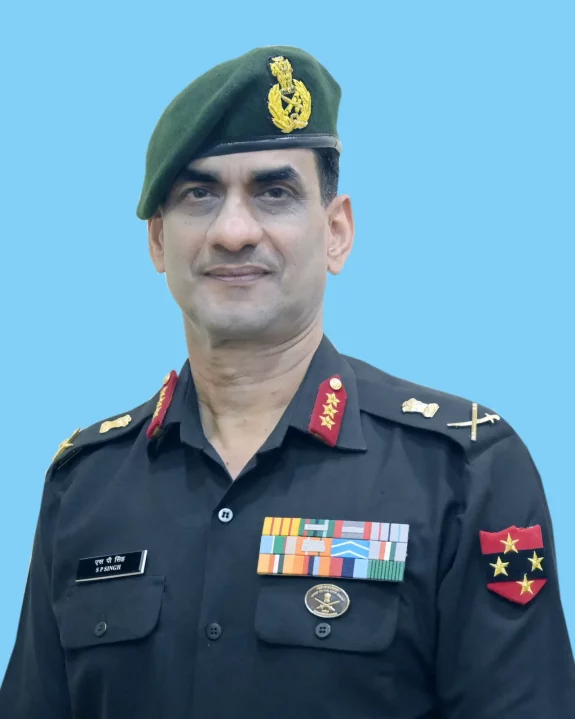
For the Indian Army, ARTRAC sits at the centre of this transition. The command is tasked with shaping how training is conceived and delivered, how doctrine evolves, and how operational lessons are translated into future preparedness. Its work directly affects the quality of training received by officers and soldiers across the force.
Lt Gen Shrinjay Pratap Singh’s career profile is well matched to those responsibilities. He has commanded in conventional infantry roles, led troops in counter-insurgency and counter-terrorism settings, served in mountain warfare environments, handled corps-level leadership and later moved into strategic intelligence. That combination gives him a view of both the realities of battlefield command and the broader security trends that shape military planning.
His professional military education is equally extensive. He is an alumnus of the National Defence Academy at Khadakwasla, the Indian Military Academy at Dehradun, the Defence Services Staff College, the Army War College at Mhow and the United States Army War College at Carlisle. He also holds a master’s degree from the University of Madras and an MPhil from Devi Ahilya Vishwavidyalaya.
That educational background, spread across command, staff and higher military studies, complements the range of assignments he has held in service. For senior commanders, such preparation is increasingly relevant as they are expected to assess not only tactical and operational issues but also strategic trends, emerging technologies and the changing nature of military competition.
Lt Gen Shrinjay Pratap Singh also comes from a military family closely associated with the Kumaon Regiment. His father, Major Dhirendra Nath Singh, served as an infantry officer in the regiment and was a veteran of the 1965 India-Pakistan War. His brother, Lieutenant General Viresh Pratap Singh Kaushik, is also a serving Indian Army officer and belongs to the Kumaon Regiment.
The family’s association with the Army spans generations, and the incoming ARTRAC chief’s own career has remained rooted in infantry service. His professional path reflects the traditional infantry emphasis on discipline, fieldcraft, physical fitness and soldiering, while his later appointments have expanded his exposure to higher command, intelligence and strategy.
His distinguished service has been recognised with the Ati Vishisht Seva Medal and Yudh Seva Medal, along with a Chief of Army Staff Commendation and several service and campaign decorations. The Ati Vishisht Seva Medal was awarded to him in 2025.
The transition to Army Training Command comes as the Indian Army places greater emphasis on realistic training, technological adaptation and the rapid absorption of lessons from contemporary conflicts. Recent conflicts have highlighted the importance of battlefield awareness, precision engagement, unmanned systems, counter-unmanned capabilities, electronic warfare and quick decision-making.
But the challenge for ARTRAC is not only to introduce technology into training. It must also ensure that such capabilities are woven into the fundamentals of military effectiveness, including leadership, tactical proficiency, physical fitness, discipline, morale and unit cohesion. Preparing commanders and soldiers to function under uncertainty remains a core requirement.
Lt Gen Shrinjay Pratap Singh’s current intelligence background is expected to add another layer to that task. As Director General of the DIA, he has been involved in higher-level intelligence assessment and coordination, while his earlier operational assignments have given him direct ground-level command experience. Together, those perspectives can help connect emerging threat assessments with training and doctrinal needs.
His rise through the Army also reflects the career progression of a combat-arms officer through successive levels of responsibility, from battalion and brigade command to division, corps and strategic appointments. Experience across operational formations and higher headquarters gives him a broad understanding of how doctrine, training, intelligence and operational readiness feed into each other.
His forthcoming move from the DIA to ARTRAC therefore represents a shift from assessing the contemporary security environment to helping prepare the Army for the challenges that may emerge from it. As GOC-in-C ARTRAC, he will be responsible for shaping training and doctrine for a force that is seeking to become more technologically enabled, agile and adaptable.


