
Lt Gen Ajay Chandpuria Highlights Key Operation Sindoor Lessons at Army War College

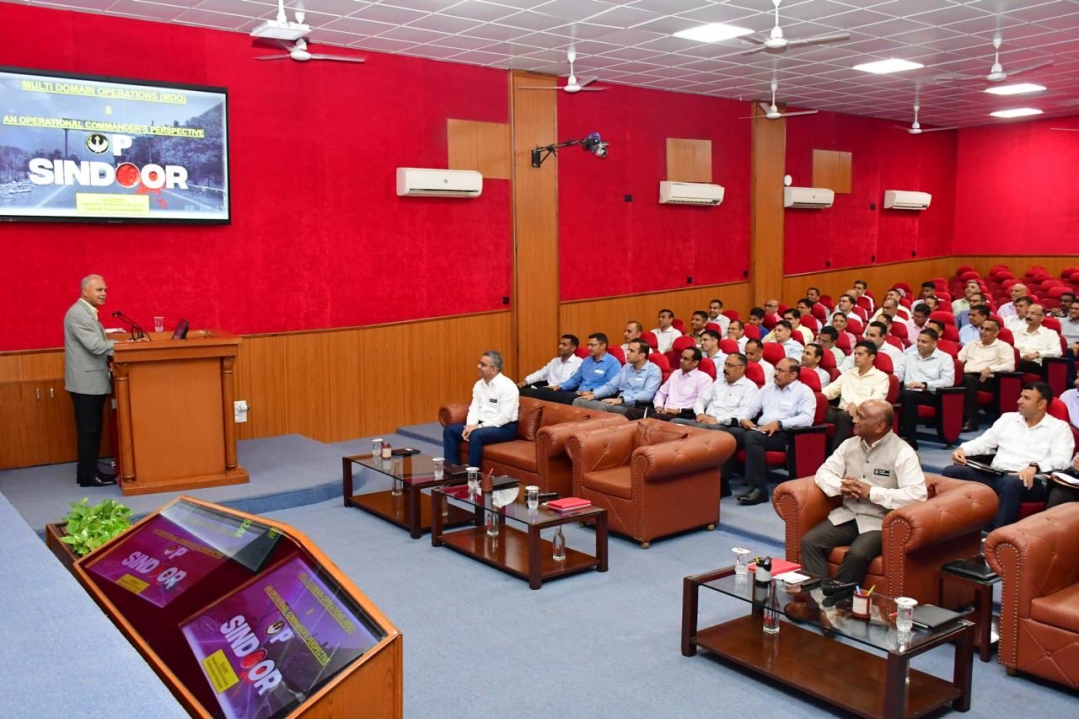
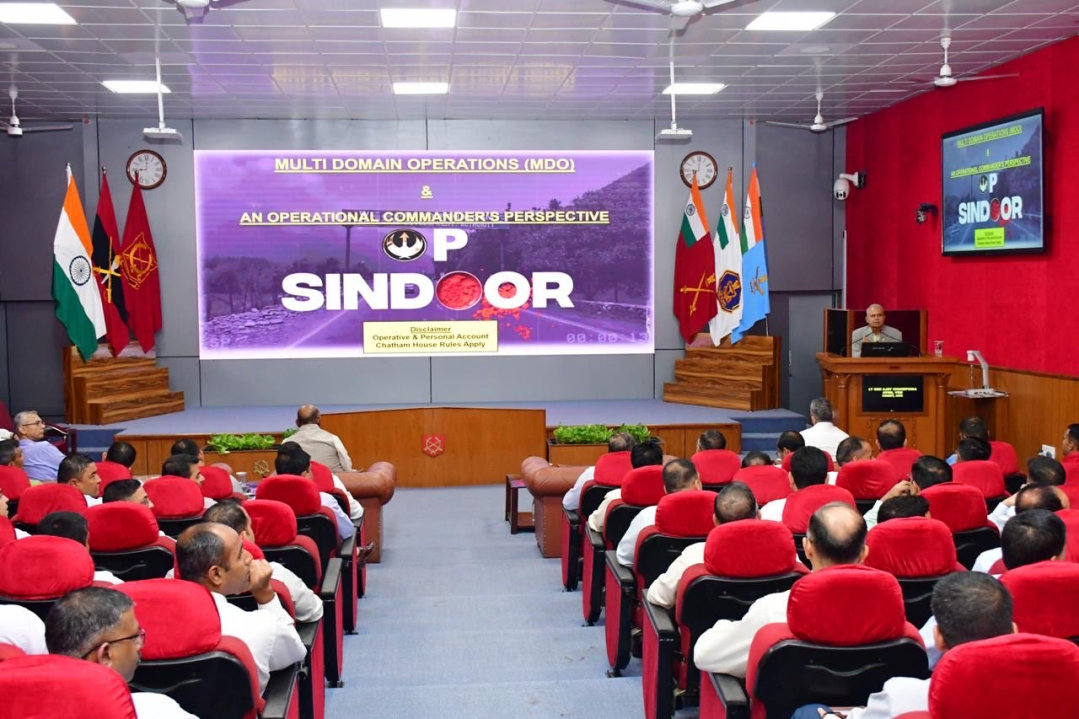
Lieutenant General Ajay Chandpuria, Commandant of the Army War College, used a session with officers of the Higher Command Course to examine Operation Sindoor as a case study in modern warfare, outlining what he described as the key requirements for planning and conducting Multi Domain Operations in a contemporary strategic environment.
Addressing senior officers preparing for higher command, staff and operational responsibilities, Lt Gen Chandpuria analysed the operation through the lens of today’s battle space, where success is increasingly shaped by the coordinated use of capabilities across land, air, maritime, space, cyber, electromagnetic and information domains.
At the centre of his assessment was the need for synchronised Higher Defence Planning. Drawing lessons from Operation Sindoor, the Army War College Commandant said modern military campaigns cannot be planned in isolation by individual Services. They demand close coordination among the Services and with other instruments of national power, so that strategic objectives, operational plans and tactical actions remain aligned with clearly defined national aims.
He pointed out that such synchronisation becomes especially important in fast-moving situations, where strategic-level decisions can quickly affect operations unfolding across several domains at once. In such conditions, effective coordination allows commanders to employ available military capabilities in a coherent manner while retaining the flexibility needed to adapt to a changing security environment.
Lt Gen Chandpuria also stressed that effective execution of Multi Domain Operations is now a basic requirement for success in war. In his formulation, the concept moves beyond the traditional service-specific use of force and instead focuses on generating coordinated effects through simultaneous action in different domains.
His remarks reflected the changing character of the battlefield. Contemporary operations are shaped not only by conventional weapons systems, but also by drones, precision-guided munitions, surveillance networks, satellites, electronic warfare tools, cyber capabilities, communications architecture and information operations. The ability to integrate these elements, he indicated, can create decisive operational advantages for commanders.
Operation Sindoor, in that sense, provided a current and relevant framework for understanding how military capabilities can be synchronised to achieve defined objectives while responding to developments in a complex operational environment.
Another major theme in the Commandant’s address was escalation control, coupled with the need for a clear exit strategy. He highlighted that military planners, particularly in a sensitive strategic setting, must think beyond the opening phases of an operation and its immediate goals. They must also determine how escalation will be managed and how a confrontation can be brought to a close on favourable terms.
A well-defined exit strategy, he noted, keeps military action tied to broader political and strategic objectives. It also gives decision-makers options to regulate the intensity and duration of a conflict, while preserving enough military capability to respond if circumstances shift.
The emphasis on escalation management reflected a wider point about the complexity of present-day conflict. Military actions no longer produce effects only on the battlefield. Strategic communication, diplomatic engagement, economic considerations and international perceptions can all develop alongside combat operations and shape the overall course of a crisis.
Within that broader environment, Lt Gen Chandpuria identified credible Information Operations as another essential pillar of contemporary warfare. With instantaneous communications, social media platforms and competing narratives shaping public understanding in real time, the information domain has become a central component of both military operations and national strategy.
He said Information Operations can be critical for conveying national intent, countering misinformation and hostile narratives, preserving public confidence and ensuring that factual information reaches audiences at home and abroad. But he also underlined that credibility is indispensable. Strategic communication, he argued, must be consistent and reliable, especially during rapidly evolving military situations in which inaccurate or misleading claims can spread quickly.
The Commandant further argued that success in modern war requires a Whole of Nation Approach. In his assessment, contemporary conflicts are no longer decided solely by fighting forces at the front. A country’s national resilience, technological capabilities, economic strength, industrial capacity, diplomatic engagement, intelligence systems, cyber resources, media awareness and public support all contribute to its ability to sustain military action and achieve strategic objectives.
That approach, he said, demands tighter coordination between the Armed Forces, government institutions, industry, technological organisations and other elements of national power. Such integration becomes even more relevant as warfare grows more technology-intensive and more interconnected across domains.
The interaction gained additional importance because of the audience it addressed. The Higher Command Course is designed to prepare senior officers for future leadership in command, staff and operational appointments. Discussions rooted in contemporary operations offer these officers a chance to study how strategic decision-making connects to operational execution in real-world conditions.
The Army War College, where the session was held, plays a key role in shaping military leadership and advancing professional military education on emerging concepts of warfare. Examining recent operational experience allows future commanders to assess changing threats, technological shifts and doctrinal demands within a realistic strategic setting.
In his assessment of Operation Sindoor, Lt Gen Chandpuria drew together four linked imperatives for contemporary military success: synchronised Higher Defence Planning, effective execution of Multi Domain Operations, escalation control supported by a clearly defined exit strategy, and credible Information Operations backed by a Whole of Nation Approach.
Taken together, those themes point to a larger transformation in warfare itself. The emphasis is shifting away from predominantly platform-centric and service-specific methods of fighting towards integrated campaigns that combine military, technological, informational and broader national capabilities.
The discussion at the Army War College also reinforced the importance of continuously studying current operations and converting those lessons into professional military education. The insights drawn from Operation Sindoor are expected to feed into the continuing evolution of concepts related to jointness, multi-domain warfare, strategic communication and integrated defence planning.
By framing Operation Sindoor in this way for officers of the Higher Command Course, Lt Gen Ajay Chandpuria highlighted a central lesson for future military leaders: warfare can no longer be understood simply as a contest of forces on the battlefield, but as the coordinated application of national power across multiple, interconnected domains.


