
‘Iron Lady of Assam’ Dr. Sanjukta Parashar Appointed CRPF Inspector General on Central Deputation

Dr. Sanjukta Parashar, the 2006-batch IPS officer of the Assam-Meghalaya cadre widely known as the “Iron Lady of Assam”, has been appointed Inspector General in the Central Reserve Police Force on central deputation. The Ministry of Home Affairs issued the formal appointment order on 6 August 2026, placing one of India’s most prominent women police officers in a senior leadership role in the country’s largest Central Armed Police Force.
The appointment brings to the CRPF an officer whose career has spanned frontline counter-insurgency operations in Assam, complex counter-terror investigations at the National Investigation Agency, and senior intelligence-led policing responsibilities in the state. Her professional profile has long stood out for combining direct field command with investigative and institutional experience.
From Assam to the IPS
Born on 3 October 1979 in Assam, Parashar was raised in a family associated with public service. Her father, Dulal Chandra Barua, served as an engineer in the state’s Irrigation Department, while her mother, Meena Devi, worked with the Assam Health Services. She studied at Holy Child School, Guwahati, and Army School, Narangi, before moving to Delhi for higher education.
Her academic trajectory was unusually extensive for a police officer. She earned a B.A. (Honours) in Political Science from Indraprastha College for Women, University of Delhi, followed by an M.A. in International Relations from Jawaharlal Nehru University. She went on to complete an M.Phil. and a Ph.D. in American Foreign Policy from JNU’s School of International Studies. Her doctoral work included field research in Indonesia.
In the 2005 UPSC Civil Services Examination, she secured All India Rank 85. Although that rank would have enabled her to choose the Indian Administrative Service, she opted instead for the Indian Police Service. She joined the IPS on 29 August 2006 and was allotted the Assam-Meghalaya cadre. She later became the first Assamese woman IPS officer to be posted in Assam itself, at a time when relatively few women from the Northeast were choosing field policing assignments in their home region.
Field postings and counter-insurgency record
Parashar’s first posting came in 2008 as Assistant Commandant in Makum, Assam. She was soon moved to Udalguri, where she was tasked with handling severe ethnic violence involving Bodo communities and migrant groups. She later served as Superintendent of Police in Jorhat and in other districts, where her work focused on law-and-order management as well as community relations.
Her most closely watched tenure was in Sonitpur district, where she served as Superintendent of Police during a period of strong factional activity by the National Democratic Front of Bodoland. In difficult forest terrain, she personally led counter-insurgency operations and built a reputation for operating well forward in the field. Over roughly 15 months, she directed 16 major encounters. Those operations resulted in 16 militants being neutralised and 64 insurgents arrested, with large quantities of arms, ammunition and explosives recovered.
Accounts from that period also recorded a wider impact from district policing efforts under her charge: 172 militants were sent to jail in 2013 and another 175 in 2014. She was frequently photographed leading CRPF teams in dense jungle areas while carrying an AK-47, an image that came to define her public profile. Her readiness to lead from the front, in areas where few senior officers ventured, contributed heavily to the enduring “Iron Lady of Assam” label.
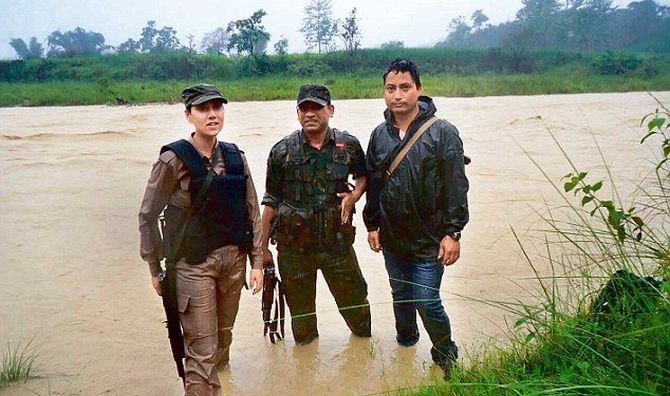
Her operational approach was not limited to armed action. The policing model associated with her tenure combined human intelligence, technical surveillance, disruption of financial networks and pressure on local support structures used by insurgent groups. At the same time, she emphasised community policing, organising medical camps, relief efforts and outreach to families of influenced youth in an effort to encourage surrenders and improve local trust. That combination of force and engagement was seen as helping strengthen the flow of information from the ground, even as she continued to face repeated death threats from militant organisations.
NIA deputation and promotion to IG
From around 2017 to 2023, Parashar served on central deputation with the National Investigation Agency in New Delhi. During this period, she first worked as Superintendent of Police and later as Deputy Inspector General. The assignment moved her from district command and counter-insurgency field operations into high-level counter-terror investigations involving terror networks, terror financing, cross-border linkages and insurgency-related cases.
One of the high-profile investigations associated with her NIA tenure was the probe into the 2017 Bhopal–Ujjain passenger train bombing. The posting added a major investigative dimension to a career already shaped by operational policing in conflict-affected areas.
She received proforma promotion to the rank of Inspector General of Police (Super Time Scale) with effect from 1 January 2024. After that, she returned to Assam and took charge as Inspector General of Police (CID-I) in Guwahati, where she handled intelligence-led investigations and strategic responses to security challenges in the state.
Recognition and professional standing
Parashar’s service has been recognised through multiple honours reflecting both her field record and her role in training and capacity building. These include the President’s Police Medal for Distinguished Service / Meritorious Service, the Union Home Minister’s Medal for Excellence in Police Training in 2022, and the Rani Gaidinliu Zeliang Award for women’s empowerment.
The Home Minister’s Medal for Excellence in Police Training was awarded for her work as a trainer of investigators, including coordination with international partners such as the FBI and other foreign police agencies. Taken together, the awards point not only to operational achievement but also to her contribution to strengthening investigative standards and advancing the visibility of women in policing.
Why the CRPF posting matters
The CRPF is India’s principal internal security force and is regularly deployed in counter-insurgency operations, anti-Naxal duties, election security, VIP protection and support to state police forces. In that context, Parashar’s appointment is notable because it places an officer with direct combat-zone experience in the Northeast, national-level counter-terror investigative exposure through the NIA, and senior state-level intelligence and CID experience into the force’s leadership structure.
The move also has wider symbolic importance. Parashar has been one of the country’s most visible women officers associated with leading kinetic operations in a conflict zone. Her elevation to the rank of IG in a major CAPF reflects the expanding space for women in operational leadership roles within India’s security system.
Her career path has also drawn attention beyond policing circles. For civil services and CAPF aspirants, especially women candidates and those from the Northeast, her trajectory remains unusual: a deliberate choice of the IPS over the IAS despite securing a rank that would have permitted either route, followed by high-risk field postings, central counter-terror investigation assignments and now senior leadership in the CRPF.
With the 6 August 2026 order, Parashar moves into the latest phase of a career defined by frontline policing, counter-insurgency command, investigative work and institution-building. As she takes charge as Inspector General in the CRPF, she carries into the force the reputation she built in Assam’s conflict-affected districts and later reinforced through national security investigations.


