
NIT Calicut Engineer Athira Suresh Leaves ExxonMobil to Train at OTA Gaya

Officer Cadet Athira Suresh’s path to military training has been shaped by academic achievement, professional success and a long-standing desire to serve in uniform. Born in Kerala, she first established herself as a strong student by clearing the highly competitive IIT-JEE examination before going on to graduate in civil engineering from the National Institute of Technology, Calicut.
Those credentials could easily have carried her into a conventional high-growth career in the private sector, and in many ways they did. After completing her degree, Athira joined ExxonMobil, the global energy major, and began building a professional life in a multinational corporate environment. But even as she worked in that setting, her interest in the armed forces remained firm.
That interest was rooted in family influence. Athira’s father, Naik Suresh of the Corps of Signals, served in the Indian Army and gave her an early, first-hand view of military discipline and service. His example played a central role in shaping her decision to eventually pursue a career in the armed forces.
Her move towards the military was therefore not a second choice after civilian ambitions had faded. It was a deliberate decision to follow a calling that had remained with her even while she was advancing in academics and corporate employment. Rather than allowing a stable job to define her future, she chose to test herself for military service through the Services Selection Board.
The SSB process marked a sharp departure from the environments she had known earlier. Unlike engineering classrooms or the corporate workplace, it assessed leadership, confidence, adaptability, teamwork and the broader suitability required for a demanding life in uniform. Athira cleared the selection in her very first attempt, a key turning point that moved her from aspiration to formal military training.
She is now training at the Officers Training Academy, Gaya, where the demands of cadet life have tested her physically, mentally and emotionally. The academy environment requires cadets to constantly adapt, work in teams, maintain discipline and push beyond familiar limits. For Athira, these pressures have become part of a wider process of growth as she prepares for officer responsibilities.
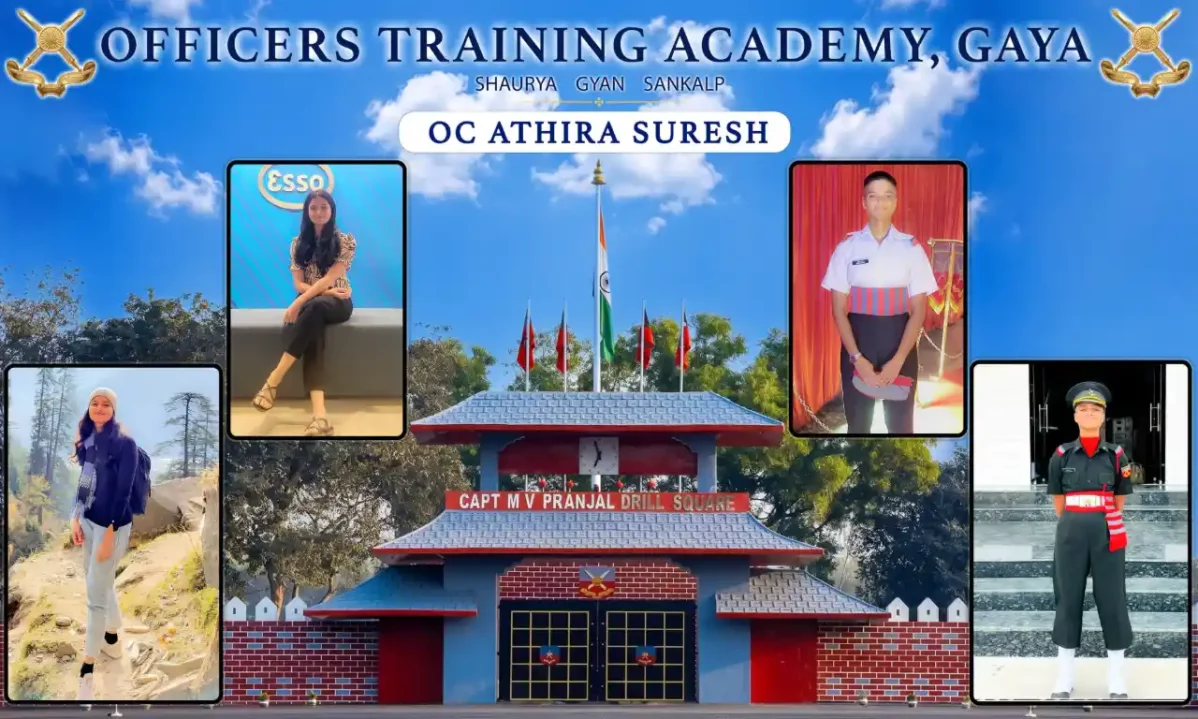
Her engineering background remains an important part of that journey. Civil engineering requires precision, planning, problem-solving and the ability to work systematically under constraints — skills that can complement the leadership and military training she is now receiving at OTA Gaya. Together, these experiences form the foundation of the officer she is working to become.
Athira’s story also reflects the changing profile of young people entering India’s armed forces. Increasingly, military academies are drawing candidates from engineering, technology, medicine, management and other professional fields. These diverse backgrounds bring different skills and perspectives into the officer corps, and Athira’s transition from a global energy company to officer training fits into that broader trend.
Her journey carries significance precisely because it combines several demanding milestones. Clearing IIT-JEE, graduating from NIT Calicut and securing a position with ExxonMobil were achievements in their own right. Choosing to leave that established path in pursuit of military service adds another dimension to her profile and underscores the seriousness of her commitment.
At OTA Gaya, she has had to move beyond the identity of an engineer and corporate professional to embrace the standards expected of a future military leader. The academy’s routine demands not only physical endurance but also emotional resilience, leadership under pressure and the ability to function effectively within a team.
For Athira, that transition has been as much about mindset as training. The source of her motivation, the influence of her father and the sense of purpose behind her decision all remain central to the way she approaches this phase of her life. Her path shows that a successful civilian career and a commitment to public service need not be mutually exclusive.
Her story is also likely to resonate with other young aspirants weighing professional security against a deeper sense of purpose. Athira’s experience suggests that success is not limited to conventional career progress or corporate advancement. In her case, the more difficult choice — leaving a stable job to enter military training — is the one that aligned with her long-term aspiration.
Now at OTA Gaya, Officer Cadet Athira Suresh continues to prepare for the olive-green uniform she has long wanted to wear. From Kerala to NIT Calicut, from ExxonMobil to the Services Selection Board, and now into officer training, her journey has been defined by hard-earned achievement and a clear decision to serve the nation.


