
Ex-IAF Chief V R Chaudhari Calls for AI-Enabled Integrated Architecture for Multi-Domain Warfare

Former Chief of the Air Staff Air Chief Marshal V R Chaudhari, PVSM, AVSM, VM (Retd), has called on the Indian Armed Forces to move well beyond routine inter-service cooperation and build a deeply integrated, digitally connected and Artificial Intelligence-enabled framework for future Multi-Domain Operations.
Addressing the Army War College on the theme of “Multi Domain Operations”, he said the changing character of warfare demands seamless fusion of capabilities across the full spectrum of military activity. In his view, modern military organisations can no longer function as separate services operating in parallel; they must increasingly behave as one integrated system.
Central to his argument was the idea of a “Structurally Synchronous Architecture” — a model that would go far beyond coordination between stakeholders during an operation. Instead, it would embed integration at the structural level, bringing together capabilities, information flows, decision-making and operational effects within a common framework.
At the heart of that model, Chaudhari said, would be a shared real-time digital operational network powered by Artificial Intelligence. Such a network could allow data from different sensors and platforms to be rapidly distributed across the battlespace, giving commanders a clearer picture of the situation and enabling faster decisions.
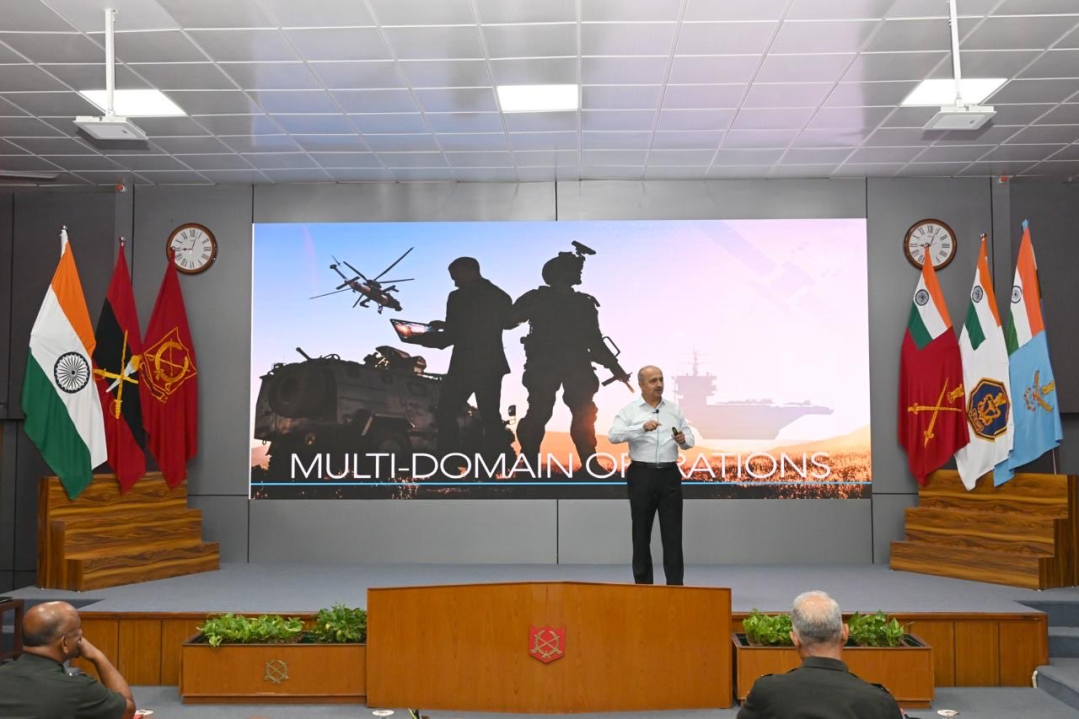
The former Air Chief’s remarks come at a time when modern warfare is producing unprecedented volumes of data through satellites, aircraft, unmanned aerial vehicles, radars, electronic intelligence systems, naval platforms, ground sensors and other intelligence, surveillance and reconnaissance assets. The advantage, he suggested, lies not only in possessing these systems but in how effectively their output can be processed, analysed and turned into action.
Artificial Intelligence, in that context, is increasingly relevant. AI-enabled tools can help sift through large battlefield datasets, identify patterns, prioritise threats and present commanders with usable information. The same systems can also support intelligence analysis, surveillance, mission planning, logistics, predictive maintenance and operational decision-making.
Chaudhari’s broader point was that future military effectiveness will depend on reducing the time between detecting a threat and responding to it. In a highly networked environment, a sensor operated by one service could feed targeting or situational information to a weapon system belonging to another service, allowing the most suitable available capability to be used against the threat.
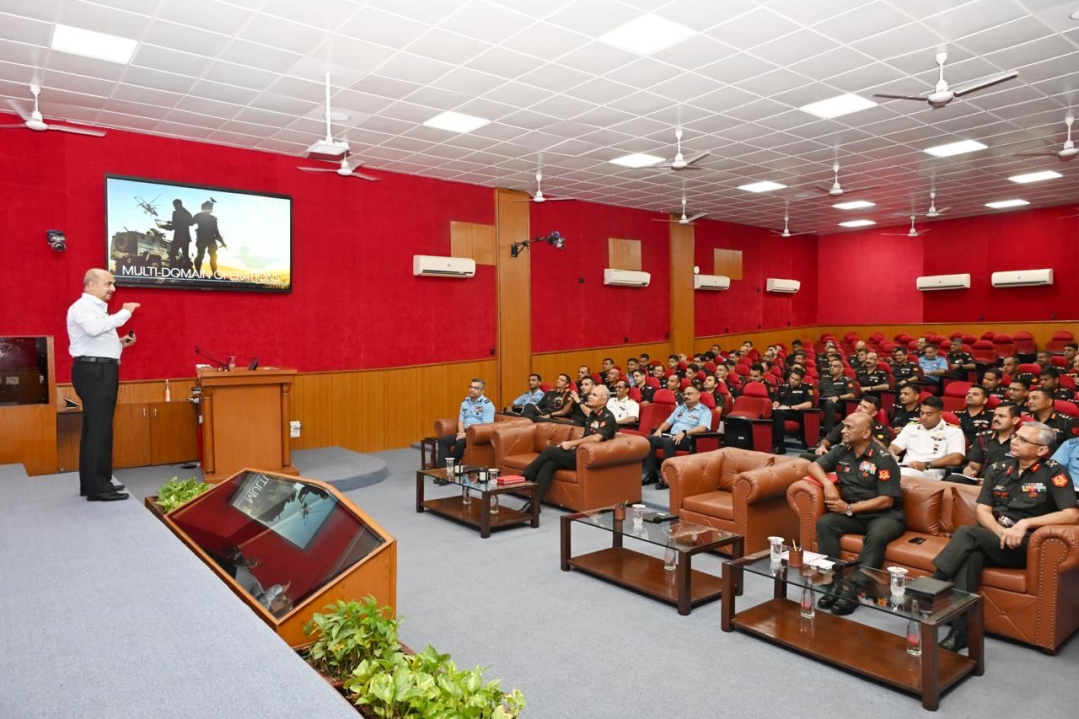
This, he indicated, is the shift from platform-centric warfare to network-centric operations. Fighter aircraft, warships, missile batteries, artillery, drones and other platforms will remain essential, but their value increases substantially when they are tied together through secure digital networks and used as part of a larger combat architecture.
Multi-Domain Operations are designed to integrate capabilities across land, air, maritime, space, cyber, electromagnetic and information environments. An operation on land, for instance, could simultaneously involve air power, satellite-based intelligence, unmanned systems, electronic warfare, cyber effects and long-range precision weapons.
The point is not merely to have different capabilities present in the same operation. Rather, they must function within a common operational framework in which information moves rapidly between sensors, commanders and shooters, while effects are synchronised across domains.
That degree of integration also places a premium on secure and resilient communications. Future networks will need to function in conditions where adversaries may seek to disrupt them through electronic warfare, cyber attacks, jamming or strikes on space-based infrastructure. As a result, resilience, cybersecurity, encryption and redundancy will become critical components of military capability.
Chaudhari’s observations are especially relevant as the Indian Armed Forces continue their broader push towards greater jointness, integration and technology-driven warfare. The Army, Navy and Air Force are operating in a battlespace where the boundaries between domains are becoming less distinct.
Cyber operations can affect air-defence networks, satellite systems can serve ground and maritime forces, electronic warfare can degrade enemy sensors and communications, and unmanned platforms can provide targeting information to weapons located hundreds of kilometres away. Coordinating these capabilities in real time can yield a major operational advantage.
Recent conflicts have further highlighted the importance of drones, long-range precision weapons, integrated air defence, electronic warfare, satellite intelligence and resilient communication networks. These trends have reinforced the view that no single weapon system or platform can independently dominate a modern battlefield.
Instead, military success increasingly depends on combining different capabilities and employing them at the right time and place. A force that can detect a threat quickly, share the information immediately and assign the most suitable weapon to engage it will have a clear edge over an adversary with slower decision-making and less integrated systems.
For India, building such an architecture will require more than buying advanced aircraft, missiles, warships, drones and surveillance systems. It will also require common operational concepts, interoperable communications, compatible data standards, joint training, secure networks and appropriate command-and-control structures.
Air Chief Marshal Vivek Ram Chaudhari served as the 27th Chief of the Air Staff of the Indian Air Force from September 2021 until his retirement in September 2024. A fighter pilot, he was commissioned into the fighter stream of the IAF on 29 December 1982 and went on to hold several key command, staff and instructional appointments during his career.
Before taking over as Chief of the Air Staff, he served as Vice Chief of the Air Staff and commanded the strategically important Western Air Command. Over the course of his service, he accumulated extensive operational and command experience and was awarded the Param Vishisht Seva Medal, Ati Vishisht Seva Medal and Vayu Sena Medal.
His address at the Army War College reflects the direction in which military operations are evolving. Future conflicts are likely to unfold simultaneously across multiple physical and non-physical domains, requiring commanders to handle huge volumes of information while making decisions under increasingly compressed timelines.
The idea of a Structurally Synchronous Architecture is therefore a call for institutionalised integration rather than ad hoc coordination. Instead of linking capabilities only when a situation demands it, the aim would be to build connectivity, information-sharing and joint employment into the system itself.
In that kind of environment, a shared, real-time and AI-enabled operational network could allow information collected anywhere across the battlespace to reach the commander, platform or weapon system best placed to act on it. That level of capability fusion could shorten decision cycles and help generate military effects across several domains at once.
As warfare becomes more digital, networked and influenced by Artificial Intelligence, autonomous systems, cyber capabilities and space-based assets, seamless integration across the Armed Forces is likely to become increasingly important to India’s military preparedness. Chaudhari’s remarks suggest that success in future conflicts will depend not only on having advanced capabilities, but on how effectively those capabilities can be fused into a single, responsive and resilient operational system.


