
Eastern Command’s Gajraj Corps Launches 4-Day Resilience Seminar in Tezpur

The Indian Army’s Gajraj Corps has begun a four-day Psychological Resilience and Adaptability Seminar in Tezpur, Assam, bringing mental preparedness, stress management and adaptability into focus for personnel operating in demanding security environments.
Held under the aegis of Eastern Command, the seminar has drawn participants from both the Indian Army and the Central Armed Police Forces (CAPFs), creating a common forum to examine the psychological and behavioural aspects of military and security operations. The initiative is aimed at strengthening the ability of personnel to cope with operational stress and maintain effectiveness under pressure.
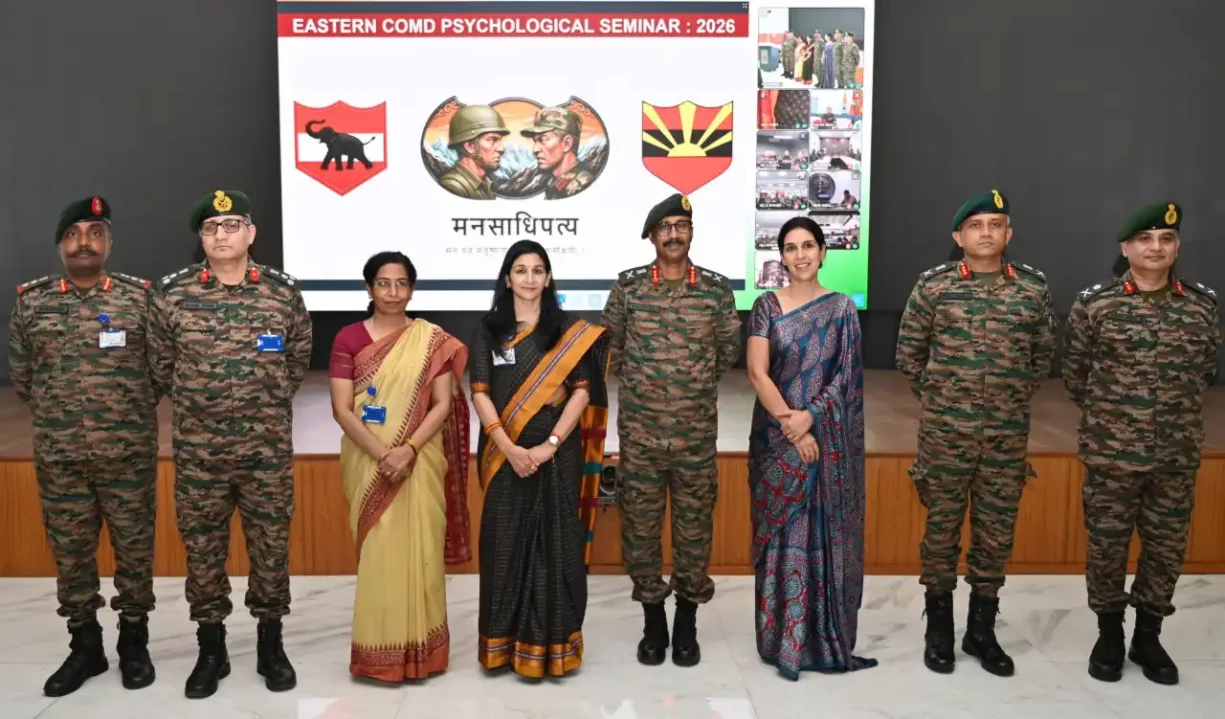
Eastern Command Army Commander Lt Gen VMB Krishnan addressed the seminar and highlighted the importance of psychological resilience and adaptability as part of operational preparedness. His presence at the event reflects the emphasis being placed at command level on human performance alongside conventional military readiness.
The programme is being conducted under the stewardship of Mrs Nishi Misra, Director of the Defence Institute of Psychological Research (DIPR), along with senior scientists from the DRDO’s DIPR. Their participation adds a specialised research-based dimension to the seminar, linking operational experience with behavioural science and psychological studies relevant to the armed forces.
The involvement of DIPR is particularly significant because the institute works on psychological research and applications for the armed forces. Its presence in Tezpur reflects the Army’s growing focus on applying scientific approaches to the pressures faced by soldiers and security personnel during prolonged deployments and demanding operations.
Mental resilience has become an increasingly important part of military preparedness as personnel are often required to work for extended periods amid uncertainty, physical fatigue, isolation and sustained operational pressure. In such conditions, the ability to stay focused, adjust to changing circumstances and take sound decisions under stress can directly affect both individual and collective performance.
Against that backdrop, the four-day seminar is designed to address psychological preparedness alongside traditional military training. Its stress-management component is intended to help personnel better understand the pressures associated with operational responsibilities and manage them without compromising professional standards.
The presence of CAPF representatives gives the initiative an inter-agency dimension. Army and CAPF personnel often operate in similarly difficult security settings, where coordination, resilience and the ability to function under pressure are critical to mission success. Bringing the two services together allows for shared learning on the challenges faced by personnel across different operational environments.
The seminar’s focus on adaptability also reflects the changing character of contemporary security operations. Personnel are increasingly required to respond to fast-moving situations while maintaining situational awareness and operational effectiveness. Psychological preparedness, in this context, complements physical conditioning, tactical skills and technology-driven capabilities.
For the Indian Army, resilience-building forms part of a broader understanding of human performance. Modern military tasks place heavy demands on personnel, making it necessary to prepare soldiers not only for physical and tactical challenges but also for the psychological strain that accompanies operational duties.
The seminar in Tezpur also fits into the Army’s wider effort to remain future-ready across diverse operational environments. While technology, intelligence and modern weapon systems remain central to military capability, the human element continues to determine how effectively those tools are translated into results on the ground.
Gajraj Corps, which functions under Eastern Command, holds an important role in the Army’s eastern theatre. The region presents a demanding operational landscape, making preparedness, adaptability and sustained professional performance especially relevant to force effectiveness.
By involving both Army and CAPF personnel, the seminar also reinforces the value of cooperation among institutions responsible for national security. Exposure to resilience-building and stress-management practices can help create a better understanding of the pressures faced by personnel across different services and operational settings.
Over the four days, the programme is expected to focus on enhancing participants’ ability to deal with psychological stress, adjust to demanding situations and sustain effectiveness during operational tasks. The broader objective is to help build personnel who can maintain composure and sound judgement under prolonged or unpredictable pressure.
The initiative also reflects a broader expansion in the idea of combat readiness. Operational preparedness is no longer limited to weapons proficiency, physical endurance and tactical drills; it now also includes psychological readiness, cognitive adaptability, leadership under pressure and the capacity to sustain performance in complex environments.
That approach has become more relevant as contemporary operations grow increasingly multidimensional. Personnel may have to manage physical strain, information overload, rapidly evolving situations and long periods of heightened alertness at the same time. Building psychological resilience is one way of ensuring that such pressures do not erode operational effectiveness.
The seminar at Tezpur, with senior Army leadership and DIPR specialists working together, represents an effort to strengthen one of the most critical elements of military capability: the ability of personnel to remain resilient, adaptable and effective under stress. By extending the programme to CAPF representatives as well, Eastern Command and Gajraj Corps have placed psychological preparedness firmly within the wider framework of operational readiness.
As security challenges continue to evolve, the ability of personnel to adapt without losing focus or effectiveness will remain central to force preparedness. The four-day seminar seeks to reinforce that capability by bringing scientific expertise, operational experience and inter-agency participation into the same room.


